BCE: Ecuador GDP Grew 3.7% in 2025 — Forecasts 1.8% for 2026

The Recovery
The Banco Central del Ecuador (BCE) confirmed that Ecuador's economy grew 3.7% in 2025, staging a robust recovery from the 2.0% contraction recorded in 2024. The turnaround was broad-based, with 16 of 20 tracked economic sectors posting positive growth — an unusually wide participation rate that signals genuine recovery rather than concentration in a single industry.
The 2024 contraction was driven by a convergence of shocks: an energy crisis that caused nationwide rolling blackouts, an internal armed conflict following the January 2024 state of emergency, and weak commodity prices in the first half of the year. The 2025 recovery reflects the normalization of these conditions and the positive impact of new trade agreements.
Demand Components
| Component | 2025 Growth | Contribution to GDP |
|---|---|---|
| Exports | +6.4% | Primary driver |
| Gross fixed investment | +5.6% | Recovery from depressed base |
| Household consumption | +2.7% | Steady improvement |
| Government spending | +1.2% | Constrained by fiscal deficit |
| Imports | +4.8% | Reflects demand recovery |
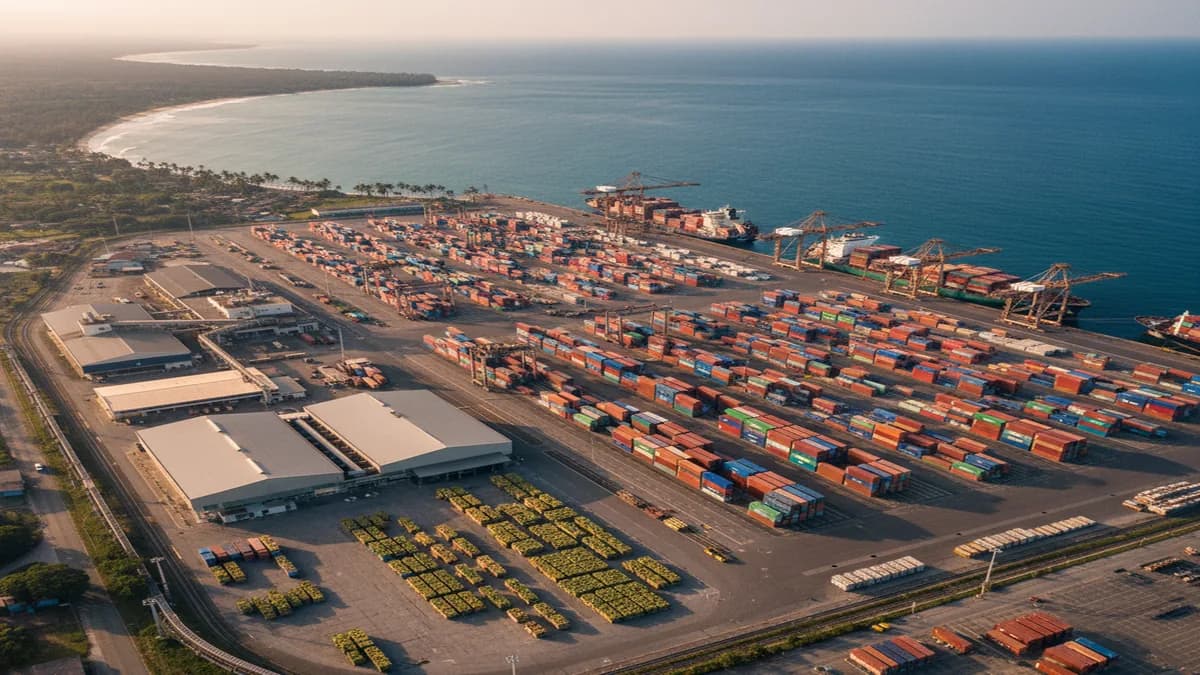
Exports were the leading growth driver at +6.4%, fueled by record shrimp shipments ($8.4 billion), strong cacao and banana performance, and improved market access through the China FTA and Canada FTA that became operational during the period. The export boom is structurally significant — it demonstrates that Ecuador's trade diversification strategy is producing measurable results.
Investment growth of +5.6% reflects a recovery from the depressed 2024 base rather than a surge in new project activity. Much of the investment growth was concentrated in mining exploration, energy infrastructure maintenance, and real estate — sectors where deferred spending from the crisis year was reactivated.
Household consumption at +2.7% is notable for a dollarized economy navigating subsidy reform and elevated food prices. Remittances from the Ecuadorian diaspora — approximately $4.5 billion annually — continue to support consumer spending, particularly in highland provinces with high emigration rates.
Sectoral Performance
The breadth of the recovery is evident in the sector-level data:
| Sector | 2025 Growth | Notable |
|---|---|---|
| Financial activities | +9.8% | Strongest performer |
| Agriculture | +8.6% | Shrimp, cacao, banana |
| Food manufacturing | +8.5% | Processing for export |
| Construction | +7.2% | Recovery from crisis |
| Transportation | +6.1% | Trade-driven |
| Telecommunications | +5.4% | Digital infrastructure |
| Retail trade | +4.8% | Consumer recovery |
| Professional services | +4.2% | Business normalization |
| Public administration | +1.8% | Fiscal constraints |
| Mining | +1.2% | Exploration phase |
| Oil & gas | -0.6% | Only major sector to contract |
Financial activities led all sectors at +9.8%, driven by credit expansion, rising deposit volumes, and increased transaction activity as the economy normalized. ASOBANCA reported that total banking system assets grew approximately 12% in 2025.
Agriculture's +8.6% growth was anchored by the shrimp sector's record $8.4 billion export year, supplemented by strong cacao harvests (driven by elevated global cacao prices above $4,000/tonne) and steady banana exports.
The oil sector's -0.6% contraction stands in stark contrast. Production of 466,400 bpd in January 2026 is below 2025 averages, reflecting field maturity, limited exploration investment, and the fuel theft crisis. Oil's decline as a growth contributor underscores Ecuador's structural transition away from hydrocarbon dependence.
2026 Outlook
Multiple institutions have published 2026 growth forecasts, with a notable spread:
| Institution | 2026 GDP Forecast |
|---|---|
| BCE | 1.8% |
| IMF | 2.0% |
| CEPAL | 2.1% |
| World Bank | 1.9% |
| Consensus (analyst avg.) | ~2.0% |
The BCE's 1.8% forecast is the most conservative, reflecting the Central Bank's assessment of several headwinds:
- Diesel subsidy pass-through — the inflation impact of the September 2025 reform has not fully propagated through the economy
- Colombia trade disruption — the bilateral tariff war removes approximately $3 billion in trade flows from the system
- Energy uncertainty — Coca Codo Sinclair's erosion risk and continued drought vulnerability constrain industrial growth
- Fiscal consolidation — the $5.3 billion deficit necessitates spending restraint that limits government's contribution to GDP
The IMF and CEPAL are slightly more optimistic, citing the positive effects of new trade agreements (U.S. ART, UAE CEPA), record non-oil exports, and mining sector investment.
Structural Indicators
| Metric | 2024 | 2025 | Trend |
|---|---|---|---|
| GDP (nominal, est.) | ~$110B | ~$114B | Growing |
| GDP per capita | ~$6,100 | ~$6,250 | Growing |
| Unemployment | 4.2% | 3.8% | Improving |
| Underemployment | 22.1% | 20.5% | Improving |
| Fiscal deficit | $4.8B | $5.3B | Widening |
| Public debt/GDP | 55% | 57% | Rising |
The juxtaposition of improving growth and employment alongside a widening fiscal deficit and rising debt defines Ecuador's macro challenge. The economy is growing, but the government's fiscal position is not keeping pace — creating a structural tension that will eventually require either sustained consolidation or higher revenue capture from the expanding export base.
What to Watch
- Q1 2026 GDP data — the first quarterly reading will signal whether the BCE's conservative 1.8% forecast or the IMF's more optimistic 2.0% is tracking closer to reality
- Non-oil export momentum — whether the $29.4 billion non-oil export performance in 2025 can be sustained or expanded through the ART and CEPA agreements
- Investment pipeline conversion — the gap between announced mining and energy investments and actual capital deployment will determine whether investment contributes to 2026 growth
- Remittance flows — U.S. economic conditions directly affect Ecuadorian diaspora earnings and remittance volumes, which underpin household consumption
- Oil production trajectory — further declines would widen the divergence between the oil sector and the rest of the economy
Sources: Primicias, BCE
Support the EcuadorBrief archive.
Research support helps fund review, corrections, and hosting. New publishing is paused.