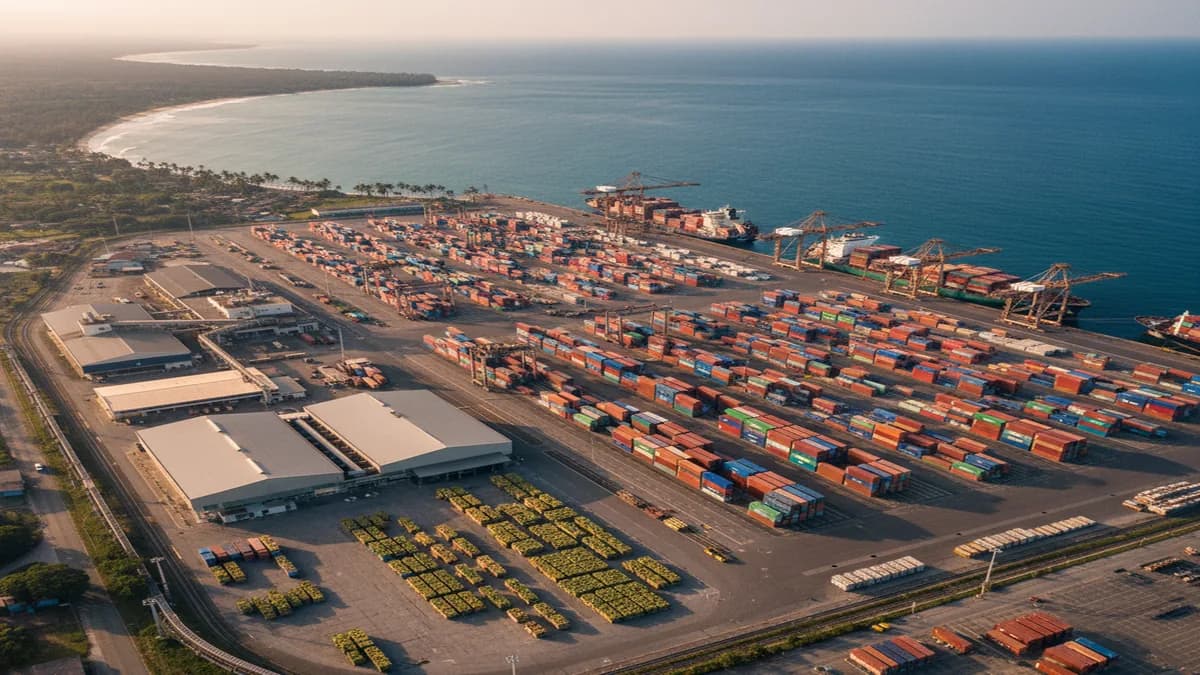
Ecuador GDP Forecast 2026: 2% Growth, 1.5% Inflation, Trade Deals Could Shift Trajectory

Baseline Forecast
The International Monetary Fund (IMF) projects Ecuador's real GDP will grow 2.0% in 2026, a modest improvement from an estimated 1.8% in 2025. The forecast reflects cautious optimism about export performance balanced against domestic political uncertainty.
Key Macroeconomic Indicators
| Indicator | 2024 (actual) | 2025 (est.) | 2026 (IMF forecast) |
|---|---|---|---|
| Real GDP growth | 1.2% | 1.8% | 2.0% |
| Inflation (CPI, YoY) | 2.2% | 1.9% | 1.5% (target) |
| Unemployment | 3.5% | 3.3% | 3.2% |
| Fiscal deficit (% GDP) | -2.8% | -2.3% | -1.9% |
| Public debt (% GDP) | 57% | 55% | 53% |
| Current account | -1.1% GDP | -0.6% GDP | -0.3% GDP |
The 1.5% inflation forecast appears optimistic given recent data: February 2026 CPI came in at 2.6% year-over-year, driven by food price increases (+3.8% YoY) and imported input costs affected by the Colombia trade dispute.
Export Performance: The Bright Spot
Ecuador's commodity exports continue to outperform GDP growth, providing the foundation for external account improvement.
Shrimp: Record $7.5B Year
| Year | Shrimp Exports | YoY Growth | Top Destinations |
|---|---|---|---|
| 2023 | $5.8B | +8% | China (55%), EU (18%), U.S. (12%) |
| 2024 | $6.1B | +5% | China (52%), EU (19%), U.S. (13%) |
| 2025 | $7.5B | +23% | China (48%), EU (20%), U.S. (15%) |
The $7.5 billion shrimp export year in 2025 was driven by:
- Volume growth — production expanded to an estimated 1.2 million metric tons
- Price recovery — global shrimp prices stabilized after the 2023 correction
- U.S. market diversification — Ecuadorian shrimp gained share against Indian and Vietnamese competitors
- CNA industry investment — the Cámara Nacional de Acuacultura reported $400M+ in new hatchery and processing capacity
Bananas: January Surge
Banana exports in January 2026 grew 9.7% year-over-year, according to AEBE (Asociación de Exportadores de Banano del Ecuador):
| Metric | Jan 2025 | Jan 2026 | Change |
|---|---|---|---|
| Export volume | 32.1M boxes | 35.2M boxes | +9.7% |
| Export value (est.) | $290M | $325M | +12.1% |
| Average price/box | $9.03 | $9.23 | +2.2% |
The growth reflects expanded acreage in Los Ríos and El Oro provinces and increased demand from the EU and Middle Eastern markets. The U.S. reciprocal trade agreement (signed March 13) could further accelerate U.S.-bound banana exports by eliminating tariffs.
Upside Catalysts
1. U.S. Reciprocal Trade Agreement The March 13 deal eliminates tariffs on $2.786 billion in non-oil exports to the United States. The Banco Central del Ecuador (BCE) estimates the agreement could add 0.3-0.5 percentage points to GDP growth if fully implemented by Q3 2026.
2. Mining Investment Pipeline Decree 273's regulatory framework unlocks $14B+ in potential mining investment. Even partial advancement of the Cascabel and Llurimagua projects would generate significant construction employment and capital goods imports. FocusEconomics estimates mining sector growth could contribute 0.2-0.4 percentage points to GDP by 2027.
3. Oil Price Stability Brent crude at $72-78/bbl supports Ecuador's fiscal position. Each $1/bbl increase in oil prices generates approximately $60 million in additional government revenue.
Downside Risks
1. Colombia Trade War The escalation to 50% mutual tariffs threatens a $2.8 billion bilateral trade corridor. Pharmaceutical and agrochemical import cost increases are already feeding into inflation. A prolonged dispute could subtract 0.3-0.5 percentage points from GDP growth.
2. Labor Protests and Political Instability President Noboa's 38% approval rating and the March 13 mass protests signal rising political risk. Sustained labor unrest could disrupt economic activity in Quito and Guayaquil, deter investment, and delay implementation of trade and mining reforms.
3. Inflation Overshoot The 2.6% February CPI reading overshoots the IMF's 1.5% annual forecast. If the Colombia tariff impact persists and food prices continue rising, the BCE may need to adjust its inflation expectations, potentially above 3.0% for full-year 2026.
4. Energy Supply Constraints Ecuador's grid remains vulnerable to drought-driven hydroelectric shortfalls. Another energy crisis similar to 2024 could reduce industrial output by an estimated 0.5-1.0 percentage points.
Scenario Analysis
| Scenario | GDP Growth | Probability | Key Driver |
|---|---|---|---|
| Bull case | 2.8-3.2% | 20% | Trade deal ratified, mining investment accelerates, Colombia de-escalation |
| Base case | 1.8-2.2% | 50% | Trade deal delayed, moderate mining progress, Colombia stalemate |
| Bear case | 0.8-1.2% | 25% | Colombia war deepens, energy crisis, election-year paralysis |
| Recession | Below 0% | 5% | Multiple shocks — commodity crash, political crisis, energy failure |
What to Watch
- Q1 2026 GDP data (release expected May) — will confirm whether the export-led growth trend is materializing
- Monthly CPI releases — March and April data will indicate whether the February inflation spike is transitory or structural
- National Assembly ratification of the U.S. trade agreement — the single highest-impact economic policy variable for 2026
- Colombia mediation outcome — the Lima Group meeting (March 23-24) could signal de-escalation or entrenchment
- Mining concession registry activity — application volumes in Q1-Q2 will indicate foreign investment appetite
- BCE monetary survey — credit growth data will reveal whether businesses are investing or contracting
Sources: IMF World Economic Outlook, FocusEconomics, SeafoodSource, Fresh Fruit Portal, BCE
Support the EcuadorBrief archive.
Research support helps fund review, corrections, and hosting. New publishing is paused.