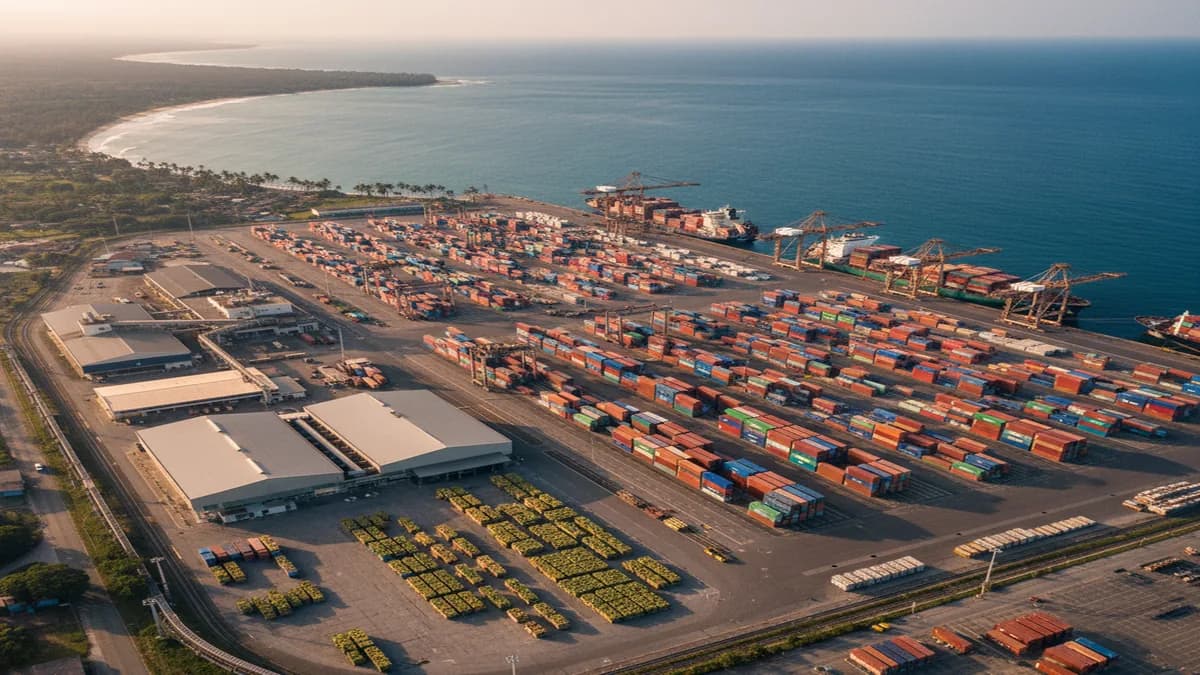
Ecuador Shrimp Exports Surge 23% YoY to 125,200 MT in January 2026

January Performance
Ecuador's shrimp exports reached 125,200 metric tonnes (MT) in January 2026, a 23% year-over-year increase from 101,800 MT in January 2025. The surge extends the strong momentum established during 2025, when the sector achieved a record $7.47 billion in export revenue.
| Period | Volume (MT) | YoY Change | Revenue (est.) |
|---|---|---|---|
| January 2026 | 125,200 | +23.0% | ~$620M |
| January 2025 | 101,800 | +8.4% | ~$490M |
| January 2024 | 93,900 | +3.2% | ~$430M |
| Full Year 2025 | ~1,180,000 | +16.8% | $7.47B |
| Full Year 2024 | ~1,010,000 | +5.1% | $6.34B |
At the January pace, annualized volume would reach approximately 1,350,000 MT, though seasonal patterns typically show a Q2-Q3 production peak.
Market Diversification
The most significant structural shift in Ecuador's shrimp export profile is the declining concentration on China:
| Market | Jan 2026 Share | Jan 2025 Share | Change |
|---|---|---|---|
| China | 49.5% | 54.2% | -4.7 pp |
| United States | 16.8% | 14.3% | +2.5 pp |
| European Union | 14.2% | 13.1% | +1.1 pp |
| South Korea | 4.8% | 4.1% | +0.7 pp |
| Japan | 3.2% | 3.0% | +0.2 pp |
| Other | 11.5% | 11.3% | +0.2 pp |
China remains Ecuador's largest shrimp market by a wide margin, but the 4.7 percentage point decline in share reflects:
- Deliberate diversification strategy by the Cámara Nacional de Acuacultura (CNA) following supply chain disruptions during China's 2023-2024 import slowdown
- Increased U.S. demand driven by competitive pricing relative to Southeast Asian producers facing anti-dumping duties
- EU market expansion following the November 2025 elimination of EU tariffs on Ecuadorian shrimp under the trade agreement
Production Dynamics
Technification
Ecuador's shrimp sector has undergone rapid technification -- the transition from traditional extensive farming to technology-intensive production:
| Method | Share of Output | Yield (kg/ha) | Growth Rate |
|---|---|---|---|
| Intensive | ~35% | 8,000-12,000 | +25% (2024-2026) |
| Semi-intensive | ~45% | 3,000-5,000 | +10% |
| Extensive (traditional) | ~20% | 800-1,500 | -5% |
Key technification investments include:
- Recirculating aquaculture systems (RAS) -- reducing water consumption by 80% and enabling year-round production
- Automated feeding systems -- improving feed conversion ratios from 1.8:1 to 1.3:1
- Genetic improvement programs -- producing specific pathogen-free (SPF) and specific pathogen-resistant (SPR) broodstock that increase survival rates from 65% to 85%+
- Real-time monitoring -- IoT sensors tracking dissolved oxygen, pH, temperature, and salinity in grow-out ponds
Geographic Concentration
Production remains heavily concentrated in coastal provinces:
| Province | Share of Production | Hectares |
|---|---|---|
| Guayas | ~55% | ~130,000 |
| El Oro | ~25% | ~60,000 |
| Esmeraldas | ~10% | ~22,000 |
| Manabí | ~7% | ~15,000 |
| Santa Elena | ~3% | ~7,000 |
Competitive Landscape
Ecuador is the world's largest shrimp exporter, competing primarily with India, Vietnam, Indonesia, and Thailand:
| Country | 2025 Exports (est. MT) | Global Share | Avg. Price ($/kg) |
|---|---|---|---|
| Ecuador | 1,180,000 | ~28% | $6.33 |
| India | 720,000 | ~17% | $5.80 |
| Vietnam | 380,000 | ~9% | $7.10 |
| Indonesia | 280,000 | ~7% | $5.50 |
| Thailand | 230,000 | ~5% | $7.40 |
Ecuador's pricing advantage over Vietnam and Thailand, combined with superior biosecurity (Ecuador has never experienced an EMS/AHPND outbreak that devastated Southeast Asian production), positions the country to continue gaining market share.
Value-Added Processing
The sector is increasing its share of value-added exports -- peeled, deveined, cooked, and breaded products -- which command premium pricing:
| Format | Share of Exports | Price Premium vs. HOSO |
|---|---|---|
| HOSO (head-on, shell-on) | ~55% | Baseline |
| HLSO (headless, shell-on) | ~20% | +15-20% |
| P&D (peeled and deveined) | ~15% | +30-40% |
| Cooked/value-added | ~10% | +50-70% |
The CNA has targeted increasing value-added exports to 30% of total volume by 2028, which would add an estimated $800 million in annual export revenue without requiring additional pond area.
Sector Outlook
The CNA projects a 15% full-year volume increase for 2026, driven by:
- New pond area -- approximately 15,000 hectares entering production in 2026
- Yield improvements from technification averaging 8-12% annually
- Favorable El Niño conditions -- warmer Pacific waters accelerate shrimp growth cycles
- Price stability -- global whiteleg shrimp prices have stabilized at $5.50-6.50/kg FOB after the 2023-2024 correction
At a 15% increase, 2026 exports would reach approximately 1,357,000 MT, with revenue potentially exceeding $8.5 billion.
What to Watch
- China demand trajectory -- any slowdown in Chinese seafood consumption would disproportionately impact Ecuador despite diversification efforts
- U.S. anti-dumping investigations -- India and Vietnam face anti-dumping duties; any extension to Ecuador would be sector-critical
- Disease risk -- while Ecuador's biosecurity record is strong, the global spread of AHPND and white spot syndrome remains an existential threat
- EU trade agreement utilization -- actual tariff savings versus administrative costs of rules-of-origin compliance
- Water resource competition -- shrimp farm expansion in Guayas and El Oro is increasingly competing with agricultural irrigation demand
Source: Undercurrent News
Support the EcuadorBrief archive.
Research support helps fund review, corrections, and hosting. New publishing is paused.