IMF Completes Fourth Extended Fund Facility Review, Approves $630 Million Disbursement as Ecuador's Recovery Outpaces Expectations

Fourth Review Completed
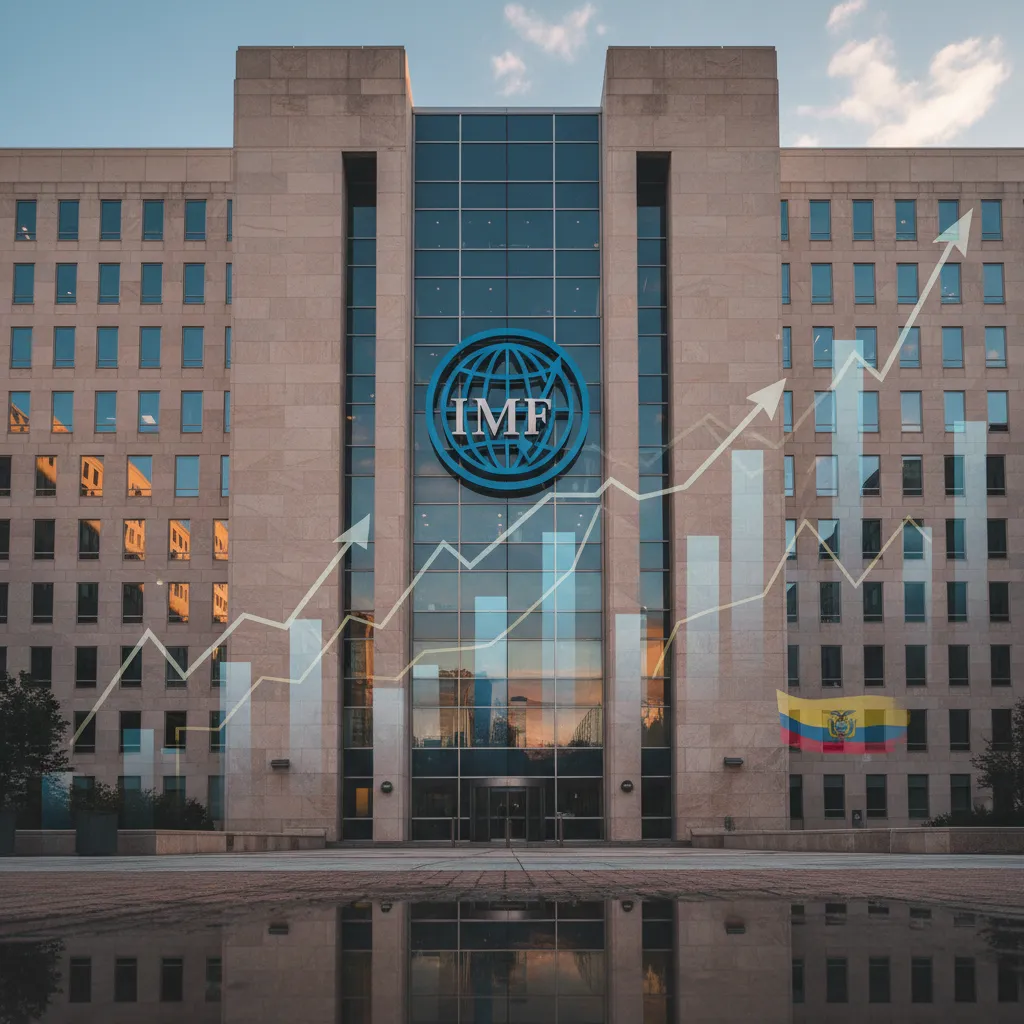
The IMF Executive Board completed the fourth review of Ecuador's Extended Fund Facility (EFF) arrangement, approving an immediate disbursement of approximately US$630 million (SDR 469.7 million). The decision brings total disbursements under the program to approximately $2.8 billion of the total $4.4 billion package approved in 2024.
The Board noted that Ecuador's economy is "recovering much faster than anticipated" — a significant upgrade in language from the third review, which described the recovery as "on track."
Program Performance
| Metric | Target | Actual | Status |
|---|---|---|---|
| End-October 2025 QPCs | All met | All met | Passed |
| Fiscal deficit (2025) | 1.2% of GDP | 0.7% of GDP | Exceeded |
| Primary balance | -0.5% of GDP | +0.1% of GDP | Exceeded |
| International reserves floor | $5.8 billion | $6.4 billion | Exceeded |
| Non-accumulation of arrears | Zero | Zero | Met |
Ecuador's fiscal outperformance — a deficit of just 0.7% of GDP versus the targeted 1.2% — reflects both stronger-than-expected tax revenues and expenditure discipline. The swing to a positive primary balance of 0.1% of GDP is particularly notable, as it indicates the government is generating enough revenue to cover all non-interest expenses.
EFF Program Structure
The Extended Fund Facility was approved by the IMF Board in April 2024 as Ecuador faced simultaneous energy, security, and fiscal crises:
| Program Detail | Value |
|---|---|
| Total arrangement | ~$4.4 billion (SDR 3,036 million) |
| Duration | 48 months (April 2024 - April 2028) |
| Disbursed to date | ~$2.8 billion |
| Remaining | ~$1.6 billion |
| Reviews completed | 4 of 8 |
| Next review | Q2 2026 |
Macroeconomic Context
The fourth review arrives amid improving economic fundamentals across multiple indicators:
| Indicator | 2024 | 2025 (Est.) | 2026 (Proj.) |
|---|---|---|---|
| GDP growth | 0.3% | 1.6% | 2.0% |
| Inflation | 2.1% | 2.5% | 2.8-3.2% |
| Unemployment | 3.8% | 3.6% | 3.4% |
| Fiscal deficit (% GDP) | 2.8% | 0.7% | 1.0% |
| Public debt (% GDP) | 57.2% | 54.8% | 53.1% |
The projected decline in public debt to 53.1% of GDP in 2026 represents a meaningful reduction from the 2024 peak of 57.2%, driven by the combination of fiscal consolidation and nominal GDP growth.
Sovereign Market Reaction
Ecuador's sovereign bond spreads have substantially narrowed since the EFF approval, reflecting improved investor confidence:
| Bond Metric | April 2024 | Current |
|---|---|---|
| EMBI spread | 1,450 bps | ~650 bps |
| 2030 bond yield | 14.8% | 9.2% |
| Moody's rating | Caa3 | Caa1 (upgraded twice) |
The two-notch Moody's upgrade from Caa3 to Caa1 — accompanied by Ecuador's successful return to international bond markets with a $4 billion issuance — demonstrates the program's catalytic effect on market access.
Structural Reform Progress
The IMF review assessed progress on structural benchmarks including:
- Tax administration modernization — SRI digital invoicing expansion and compliance improvements
- Fuel subsidy reform — Continued rationalization of diesel and gasoline subsidies
- Central bank governance — Strengthening of BCE operational independence
- Financial sector oversight — Enhanced AML/CFT framework implementation (aligning with the BCE's new 47-pattern crypto detection mandate)
- Public financial management — Treasury single account consolidation
Dollarization Safeguards
For a dollarized economy like Ecuador, the EFF program's emphasis on international reserves accumulation is particularly critical. Without the ability to print currency or devalue, Ecuador's fiscal and external buffers serve as the primary shock absorbers:
| Reserve Metric | Value |
|---|---|
| International reserves (current) | $6.4 billion |
| Import cover | ~3.2 months |
| Reserve floor (IMF target) | $5.8 billion |
| Reserve buffer above floor | $600 million |
The $600 million buffer above the IMF floor provides a modest but meaningful cushion against commodity price shocks or security-related fiscal pressures.
Regional Comparison
Ecuador's fiscal consolidation stands out among recent Latin American IMF programs:
| Country | Program | Fiscal Outcome |
|---|---|---|
| Ecuador | EFF (2024-2028) | Deficit 0.7% GDP (beat target) |
| Argentina | EFF (2022-2025) | Surplus achieved (under Milei) |
| Colombia | No active program | Deficit 4.3% GDP |
| Costa Rica | EFF (2021-2024) | Successfully completed |
What to Watch
Track the fifth review timeline — expected in Q2 2026, it will assess end-April 2026 performance criteria and could unlock another ~$630 million disbursement. Monitor fuel subsidy reform implementation — the most politically sensitive structural benchmark and a common flashpoint for social unrest. Watch sovereign spread dynamics — sustained compression below 600 bps would signal investment-grade trajectory expectations. Track the interaction between the IMF program and the US-Ecuador ART — trade deal implementation could boost fiscal revenues through expanded economic activity, further strengthening the fiscal consolidation narrative.
Sources: IMF, BCE, Primicias
Source
IMF / BCE / Primicias — “IMF Executive Board Concludes Fourth Review of Extended Fund Facility Arrangement for Ecuador”
View originalSupport the EcuadorBrief archive.
Research support helps fund review, corrections, and hosting. New publishing is paused.