TerraEarth Resources: How a Chinese-Owned Firm Amassed 10,900 Hectares of Gold Concessions in Ecuador's Amazon While Contaminating Rivers at 500x Safe Levels

10,900 Hectares Under Chinese Control
TerraEarth Resources S.A. holds 10,900 hectares across six gold mining concessions in Napo Province — an area 175 times larger than Quito's La Carolina Park. The company is controlled by two Chinese nationals: Peng Yongming (majority shareholder) and Wang Ye, with registered capital of just $580,000 and two employees.
The concessions represent a significant portion of the 31,521 hectares allocated across 146 small-scale gold mining concessions in Napo, making TerraEarth the single largest holder in Ecuador's Amazon gold belt.
Concession map
| Concession | Location | Size |
|---|---|---|
| Icho | Puerto Napo, Tena | 3,665 hectares (largest) |
| Confluencia | Puerto Napo, Tena | Part of Tena Project |
| Talag | Talag parish, Tena | Part of Tena Project |
| Anzu Norte | Puerto Napo, Tena | Part of Tena Project |
| Vista Anzu | Carlos Julio Arosemena Tola | Siguacocha Project |
| Regina 1S | Carlos Julio Arosemena Tola | 4,077 acres |
Corporate History: A Trail of Name Changes
TerraEarth's corporate evolution raises questions about how small-scale mining concessions accumulate under opaque ownership structures:
| Date | Event |
|---|---|
| October 2001 | Founded as RBBPACAY Río Verde S.A. (legal/financial advisory) |
| June 2004 | Foreign capital injection from Merendon Mining Corp (Belize-registered) |
| July 2004 | Renamed to Merendon del Ecuador S.A. |
| October 2004 | Corporate purpose changed from consulting to mineral extraction |
| September 2011 | Renamed TerraEarth Resources S.A. |
| 2017 | Chinese nationals Peng Yongming and Wang Ye become primary shareholders |
The company's 2024 financials show revenue of $2.3 million, assets of $5.9 million, and a tax declaration of just $25,894 — figures that raise questions about the relationship between concession value and reported economic activity.
Environmental Devastation: The Evidence
Deforestation
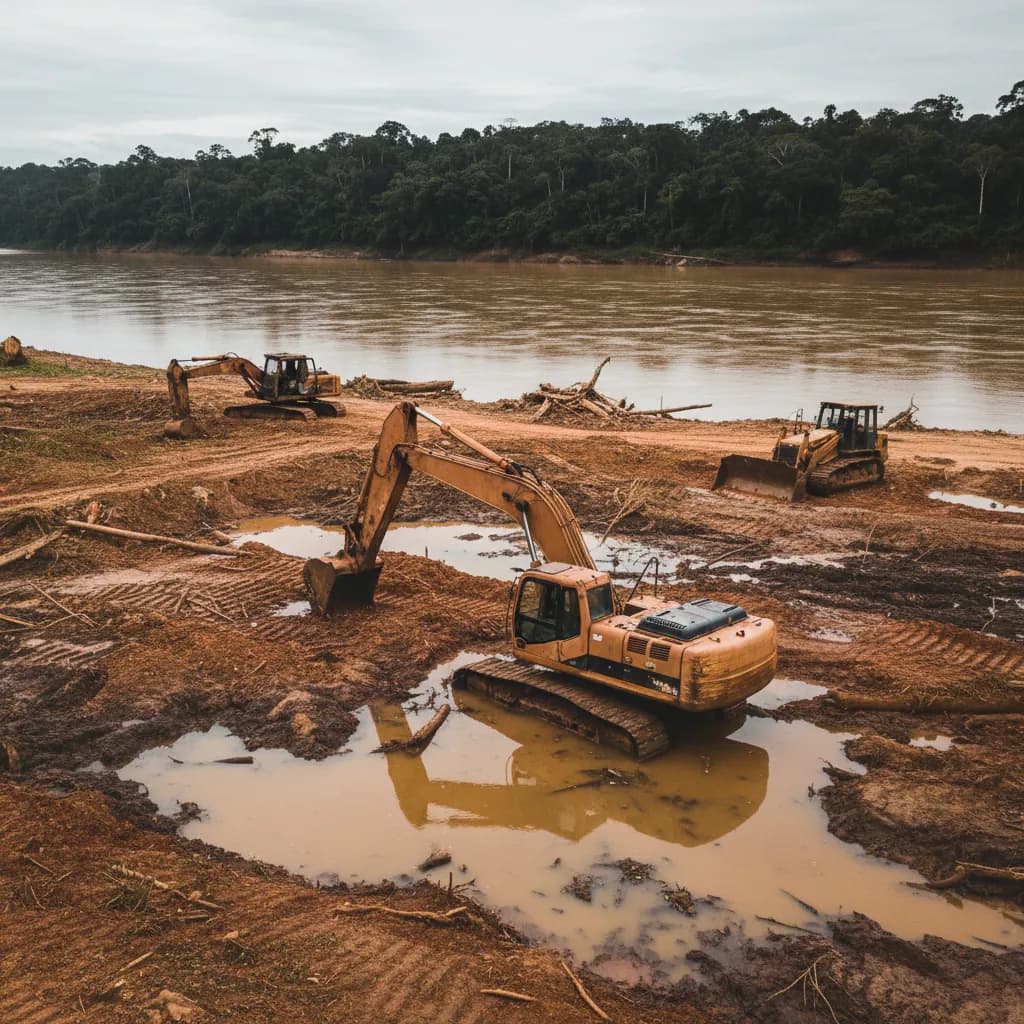
MapBiomas Amazonia satellite imagery documented nearly 700 acres deforested between March 2017 and March 2022 — approximately 400 soccer fields of Amazon rainforest cleared for gold extraction. Operations continued illegally even after the September 6, 2022 mining ban, with three mining fronts expanding between September 2022 and May 2023.
Water contamination
| River | Contamination Level | Impact |
|---|---|---|
| Chumbiyacu River | Heavy metals at 500x acceptable levels | "No life in the river — not a single fish" |
| Napo River tributaries | Mercury and cyanide at 200-700% above permitted levels | 2021 study by researcher Francisco Mestanza Ramón |
| Yutzupino River | Mercury, cadmium, lead, zinc, arsenic | Drinking water for 25 communities contaminated |
Regulatory failure
The Ministry of Energy conducted 29 monitoring inspections between 2013 and 2022. A February 3, 2022 inspection documented 55 environmental non-compliances, including direct river discharges and 55 gallons of improperly stored fuel. Despite this record, the company continued operating.
Licenses were finally suspended on May 28, 2025 by Energy Minister Inés Manzano, citing environmental violations — more than three years after the documented evidence.
Operation Manatí: The Military Response
On February 13, 2022, the government launched Operation Manatí in the Yutzupino area with more than 1,500 Armed Forces and National Police personnel. The operation revealed the scale of illegal gold mining in Napo:
| Metric | Value |
|---|---|
| Excavators operating pre-raid | 100+ |
| Workers on site | ~2,000 |
| Excavators seized | 143 (remain abandoned in Tena) |
| Water suction engines seized | 97 |
| Mineral separation machines seized | 80 |
| Fuel containers seized | 41 (265-gallon) |
| Deforestation (Oct 2021-Jan 2022) | 70 hectares |
Community Impact
TerraEarth employed deliberate community fragmentation tactics, dividing the Shiguacocha community into competing factions. Raúl Grefa, a Santa Monica community representative, stated: "The Chinese polluted the Chumbiyacu River. It is true. And they have damaged our land."
Napo Ombudsman Andrés Rojas went further: "All mining in Napo is illegal because legal procedures, environmental management plans and remediation plans have not been complied with."
Indigenous communities including the Serena community in Talag parish were allegedly unaware that concessions had been granted on their ancestral territory.
The Bigger Picture: China's Mining Footprint
TerraEarth's small-scale operations exist alongside a much larger Chinese mining presence in Ecuador:
| Chinese Company | Project | Investment | Resources |
|---|---|---|---|
| CRCC-Tongguan | Mirador (copper) | $1.4B | 3.2M tonnes copper |
| Jiangxi Copper | Cascabel (copper-gold) | $1.2B acquisition | 10.9M tonnes copper, 23M oz gold |
| CMOC Group | Cangrejos (gold) | $421M acquisition | 11.6M oz gold |
| TerraEarth | Napo (gold) | Minimal | Undisclosed |
Ecuador's total borrowing from China stands at $18.4 billion across 15 loans — the third-largest Chinese lending portfolio in Latin America after Venezuela ($67.2B) and Brazil ($28.9B).
What to Watch
Track whether TerraEarth's license suspension becomes permanent or if the company satisfies remediation requirements and resumes operations. Monitor the Fiscalía General's investigation into potential criminal environmental charges. Watch for the mining concession registry reopening (expected Q1 2026) and whether small-scale Amazon concessions like TerraEarth's are subject to new environmental standards under Decree 273. Track community legal actions — several indigenous groups have filed complaints that could set precedent for concession revocation.
Sources: Primicias, Mongabay, Latin America Bureau, MapBiomas Amazonia
Source
Primicias / Mongabay / Latin America Bureau — “TerraEarth: la empresa china que controla miles de hectáreas de concesiones mineras de oro en Napo”
View originalSupport the EcuadorBrief archive.
Research support helps fund review, corrections, and hosting. New publishing is paused.