UAE Signs $3B CEPA With Ecuador -- Clean Energy, Mining, and Tech Investment Roadmap

The Agreement
The United Arab Emirates and Ecuador signed a Comprehensive Economic Partnership Agreement (CEPA) on March 2, 2026, during the state visit of Sheikh Khaled bin Mohamed Al Nahyan, Crown Prince of Abu Dhabi, to Quito. The agreement is the most significant bilateral economic accord Ecuador has signed with a Middle Eastern partner, establishing a framework for both preferential trade access and strategic investment commitments.
Ecuador becomes the fourth Latin American country to sign a CEPA with the UAE, following Costa Rica, Chile, and Colombia. The UAE has pursued an aggressive CEPA strategy globally, signing over 20 such agreements since 2022 as part of its economic diversification away from hydrocarbon dependence.
Trade Provisions
| Provision | Detail |
|---|---|
| Tariff elimination | 96%+ of traded goods |
| Implementation | Phased over 5-10 years |
| Key Ecuador exports covered | Bananas, shrimp, cacao, flowers, tuna |
| Key UAE exports covered | Refined petroleum, aluminum, plastics, chemicals |
| Services | Financial services, logistics, digital trade |
| Rules of origin | Bilateral cumulation |
The tariff elimination covers 96% or more of traded goods between the two countries, with sensitive products phased in over longer timelines. For Ecuador, the primary benefit is duty-free access for its agricultural commodities into the UAE's re-export hub network -- goods entering the UAE duty-free can be re-exported throughout the Gulf Cooperation Council (GCC) and broader Middle Eastern markets.
Bilateral trade between Ecuador and the UAE stood at approximately $450 million in 2025, with Ecuador running a modest surplus driven by banana and shrimp exports. The CEPA is projected to increase bilateral trade to $1.2-1.5 billion within five years.
$3 Billion Investment Roadmap
The centerpiece of the CEPA is a $3 billion strategic investment roadmap spanning five priority sectors:
Renewable Energy (~$1.2B)
- Solar farm development in Ecuador's coastal provinces (Manabi, Santa Elena), where solar irradiation averages 4.5-5.0 kWh/m2/day
- Wind energy projects in the Loja province highlands
- Green hydrogen feasibility studies leveraging Ecuador's hydroelectric surplus during wet seasons
- UAE's Masdar (Abu Dhabi's clean energy company) identified as lead investor
Mining (~$800M)
- Investment in copper and gold exploration and development
- Technology transfer for water-efficient mineral processing
- Potential participation in upcoming ENAMI tenders for state-held concessions
- Focus on Ecuador's strategic minerals designated by the U.S. Critical Minerals Ministerial
Logistics & Infrastructure (~$500M)
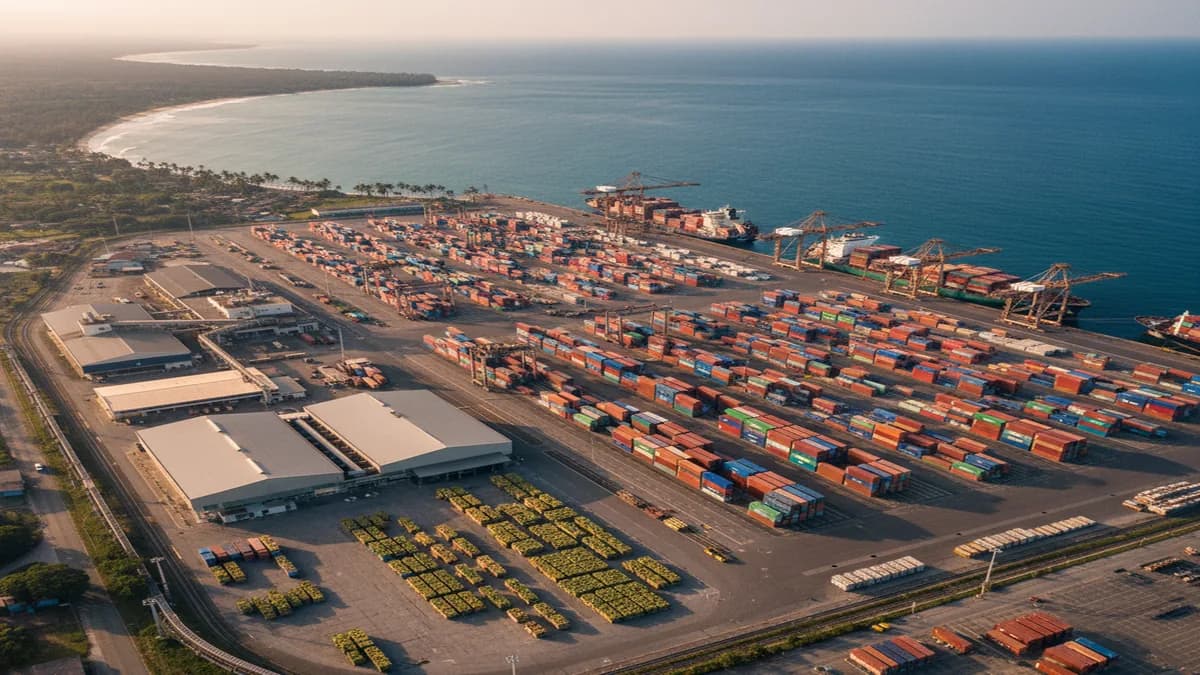
- Port modernization at Posorja (DP World already operates Ecuador's largest deep-water terminal)
- Cold-chain logistics for agricultural exports to Middle Eastern markets
- Free trade zone development modeled on Jebel Ali framework
Technology & Digital (~$300M)
- Fintech partnerships between UAE digital banking platforms and Ecuadorian financial institutions
- Smart city infrastructure pilots in Quito and Guayaquil
- Data center development leveraging Ecuador's competitive electricity rates
Agriculture (~$200M)
- Aquaculture technology transfer for shrimp farming efficiency
- Vertical farming pilot projects for food security
- Direct sourcing agreements between UAE food importers and Ecuadorian agricultural cooperatives
Defense & Security MOU
Separately from the CEPA, a $250 million Memorandum of Understanding was signed between the EDGE Group (UAE's defense technology conglomerate) and Ecuador's Ministry of Defense. The MOU covers:
- Surveillance infrastructure for Ecuador's northern border with Colombia and southern border with Peru
- Maritime patrol systems for anti-narcotics interdiction in Pacific territorial waters
- Border protection technology including drone systems, sensor networks, and command-and-control platforms
The defense MOU reflects Ecuador's escalating security spending in response to the organized crime crisis. EDGE Group, which generated $5.4 billion in revenue in 2024, has been expanding into Latin American defense markets, with previous contracts in Brazil and Mexico.
Strategic Context
The UAE-Ecuador CEPA fits within a broader pattern of Gulf state economic engagement with Latin America:
| Country | UAE CEPA Status | Investment Focus |
|---|---|---|
| Costa Rica | Signed 2023 | Tourism, logistics |
| Chile | Signed 2024 | Mining, renewables |
| Colombia | Signed 2024 | Energy, agriculture |
| Ecuador | Signed March 2026 | Energy, mining, tech |
| Peru | Under negotiation | Mining, agriculture |
For the UAE, Latin America represents a diversification play -- access to critical minerals, agricultural commodities, and investment opportunities outside traditional Gulf-Asia-Europe corridors. For Ecuador, the UAE offers a capital source that is neither Chinese nor American, providing geopolitical optionality in an era of great-power competition for Latin American resources.
What to Watch
- Masdar project announcements -- concrete solar and wind project commitments in 2026 will signal whether the $1.2B renewable energy allocation is serious capital or aspirational
- DP World Posorja expansion -- additional investment at Ecuador's premier deep-water port would validate the logistics thesis
- EDGE Group contract conversion -- whether the $250M MOU converts to binding contracts and actual equipment deliveries
- GCC market access for Ecuadorian shrimp -- if the CEPA enables duty-free transit through UAE to Saudi Arabia, Kuwait, and Qatar, it opens a new $500M+ market
- Mining concession participation -- UAE-linked investment funds bidding on ENAMI tenders (particularly Llurimagua) would represent a new competitive dynamic
Sources: Solar Quarter, Economy Middle East
Support the EcuadorBrief archive.
Research support helps fund review, corrections, and hosting. New publishing is paused.