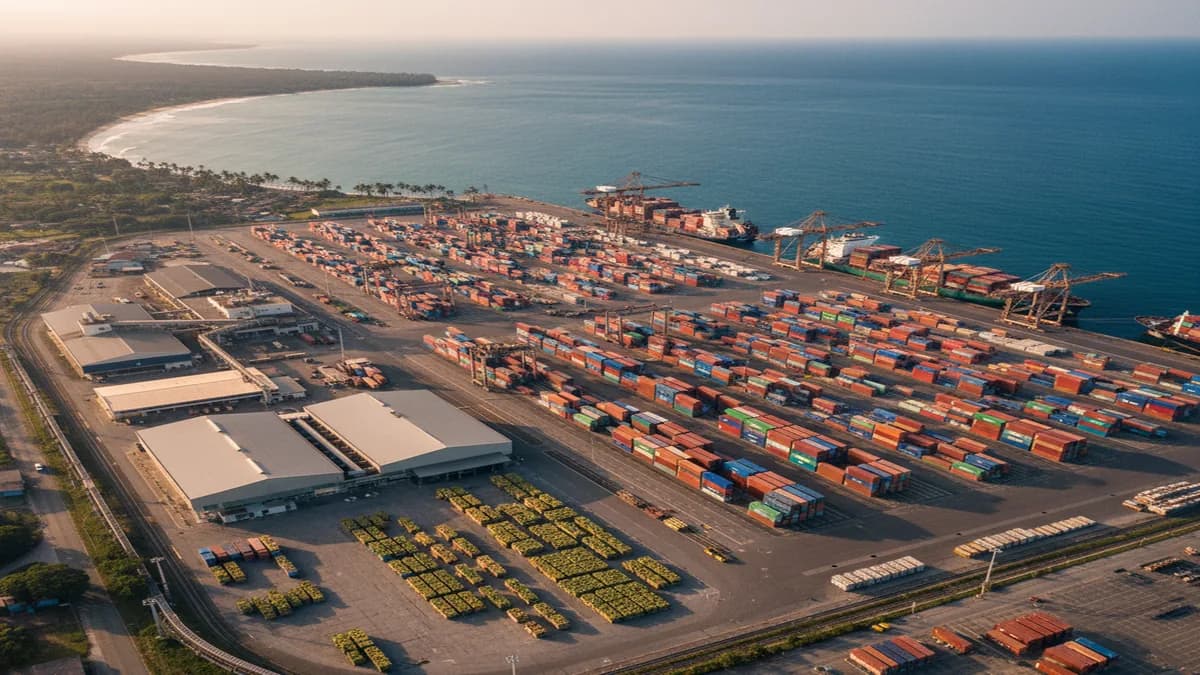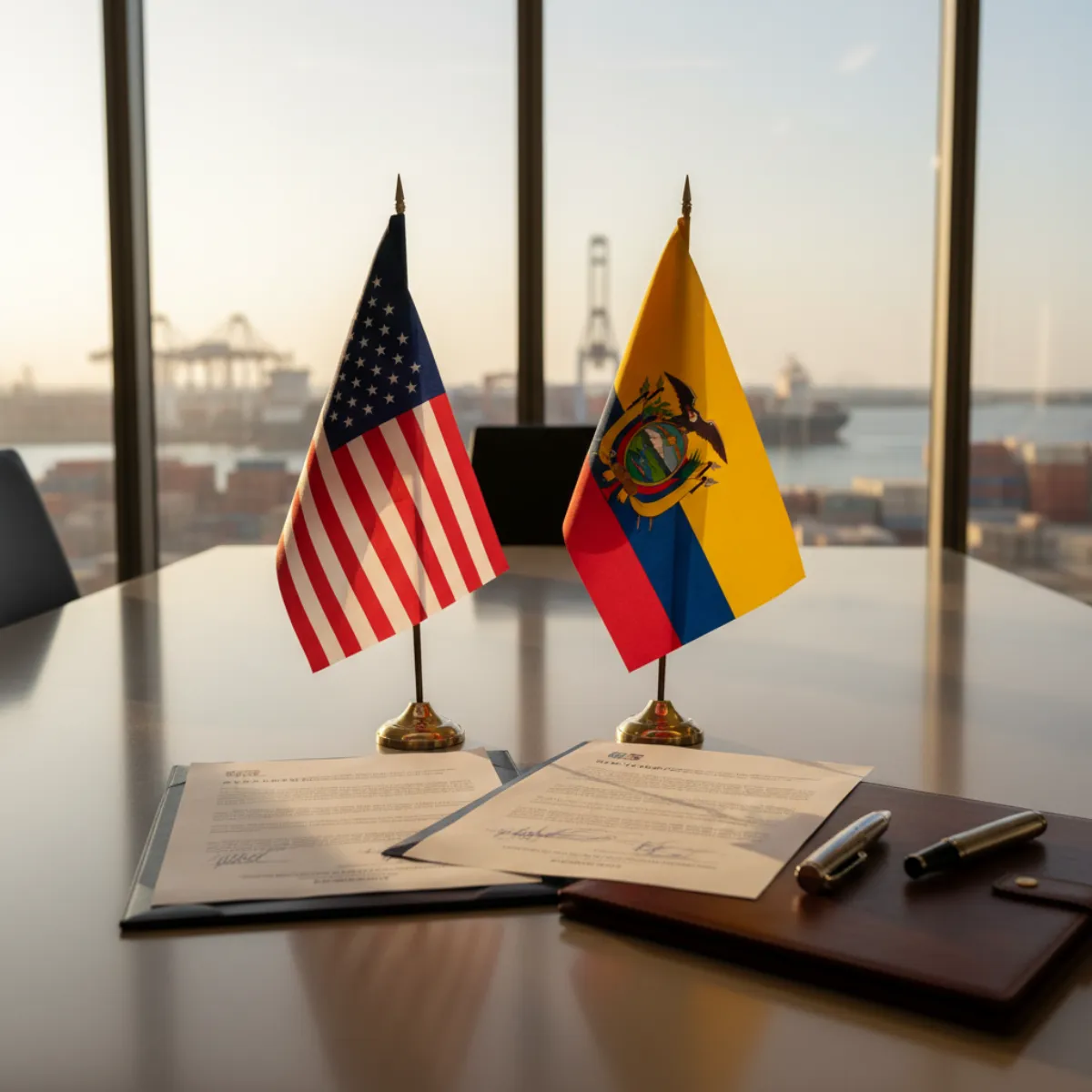
US and Ecuador Substantially Conclude Agreement on Reciprocal Trade, Eliminating 15% Tariff Surcharge on ~$3.2 Billion Non-Petroleum Export Basket

Zero Tariffs on $3.2 Billion Export Basket
The United States Trade Representative (USTR) announced on February 13, 2026 that the US and Ecuador have substantially concluded negotiations for an Agreement on Reciprocal Trade (ART), with a formal signing expected within weeks.
The agreement eliminates a 15% tariff surcharge on approximately 50% of Ecuador's non-petroleum exports to the United States — a basket valued at roughly $3.2 billion annually.
Products Covered
The following product categories gain immediate zero-tariff access upon the agreement's entry into force:
| Product | Ecuador's Global Export Rank | Estimated US-Bound Value |
|---|---|---|
| Flowers (roses) | 3rd worldwide | ~$900 million |
| Bananas | 1st worldwide | ~$600 million |
| Cacao | 1st (fine aroma) | ~$400 million |
| Tuna | Top 3 worldwide | ~$350 million |
| Shrimp | 2nd worldwide | ~$500 million |
| Blueberries | Emerging | ~$50 million |
| Avocados | Emerging | ~$30 million |
| Dragon fruit | Top 5 worldwide | ~$20 million |
| Minerals (gold, copper) | Growing | ~$350 million |
The USTR framed the agreement as designed to "promote prosperity and expand and diversify bilateral trade and investment for the mutual benefit of both countries."
Historical Context: Filling the ATPDEA Gap
The ART represents the most significant US-Ecuador trade agreement since the expiration of the Andean Trade Preference Act (ATPDEA) in 2013, which had provided duty-free access for Andean nations' exports to the US market.
| Date | Event |
|---|---|
| 1991 | Andean Trade Preference Act (ATPA) enacted |
| 2002 | ATPDEA expanded preferences |
| 2013 | ATPDEA expires — Ecuador loses preferential access |
| 2017-2020 | GSP (Generalized System of Preferences) provides partial relief |
| 2025 | Trump administration imposes 15% surcharge on Ecuadorian exports |
| Feb 13, 2026 | US-Ecuador ART substantially concluded |
For over a decade, Ecuadorian exporters operated at a competitive disadvantage relative to Colombian and Peruvian producers, which secured their own Free Trade Agreements with the US. The ART closes this gap for approximately half of Ecuador's non-petroleum export categories.
Sector-by-Sector Impact
Flowers: The sector employs 120,000 workers across 6,200 hectares of plantations. The current combined US tariff rate (15% surcharge + 6.8% existing duty = 21.8%) has squeezed margins — particularly visible in the Valentine's Day 2026 season, where volume rose 3% but revenue fell from $282 million to an estimated $274-276 million. The ART's tariff elimination would restore approximately $130-150 million in annual margin to the sector.
Bananas: Ecuador exported a record 378.41 million boxes in 2025 (6.8 million tonnes). The US market — which absorbed 14.5% more Ecuadorian bananas in 2025 — would become significantly more competitive against Central American suppliers.
Cacao: Ecuador's fine aroma cacao commands premium pricing but faces competition from Côte d'Ivoire and Ghana in processed chocolate. Zero tariffs strengthen Ecuador's position in the US artisanal and premium chocolate supply chain.
Mining: The inclusion of minerals is strategically significant, aligning with the US FORGE initiative ($30 billion) and EXIM Project Vault ($10 billion) announced in February 2026 to diversify critical mineral supply chains away from China.
Ecuador's Reciprocal Commitments
The USTR announcement did not detail Ecuador's specific reciprocal concessions. However, based on Ecuador's broader reform agenda, likely commitments include:
- Tariff reductions on US manufactured goods and agricultural products
- Strengthened intellectual property protections
- Investment protection frameworks aligned with US standards
- Regulatory transparency requirements
- Digital trade provisions
Full tariff schedules and commitment texts are expected upon formal signing.
Alignment with Broader Trade Architecture
The ART enters a complex trade landscape for Ecuador:
| Agreement | Partner | Status |
|---|---|---|
| EU-Ecuador FTA | European Union | In force since 2017 |
| Ecuador-China FTA | China | In force since 2024 |
| CAN (Andean Community) | Bolivia, Colombia, Peru | Active (but Colombia dispute ongoing) |
| US-Ecuador ART | United States | Substantially concluded |
| EFTA-Ecuador | Switzerland, Norway, Iceland, Liechtenstein | Under negotiation |
The ART's signing coincides with Ecuador's trade war with Colombia (30% mutual tariffs), creating a scenario where Ecuador simultaneously deepens US access while its Andean neighbor imposes retaliatory barriers.
What to Watch
Track the formal signing date and text release — the detailed tariff schedules will reveal the full scope of covered products and any phase-in periods. Monitor Congressional notification requirements — ARTs may face review or opposition from US agricultural interests that compete with Ecuadorian imports. Watch for Ecuador's reciprocal tariff reductions — domestic industries may resist opening to US competition. Track whether the agreement includes rules of origin provisions that could affect Ecuador's nascent manufacturing sector. Monitor the interaction between the ART and the Colombia trade war — US market access may partially offset lost Colombian trade.
Sources: USTR, The Rio Times, Ecuador Ministry of Production
Source
USTR / The Rio Times — “United States and Ecuador Substantially Conclude Negotiations for an Agreement on Reciprocal Trade”
View originalSupport the EcuadorBrief archive.
Research support helps fund review, corrections, and hosting. New publishing is paused.