US-Ecuador Reciprocal Trade Deal 'Substantially Concluded' With Full Tariff Elimination — Shrimp Sector Demands Inclusion in Final Product List

US-Ecuador Trade Deal Nears Completion
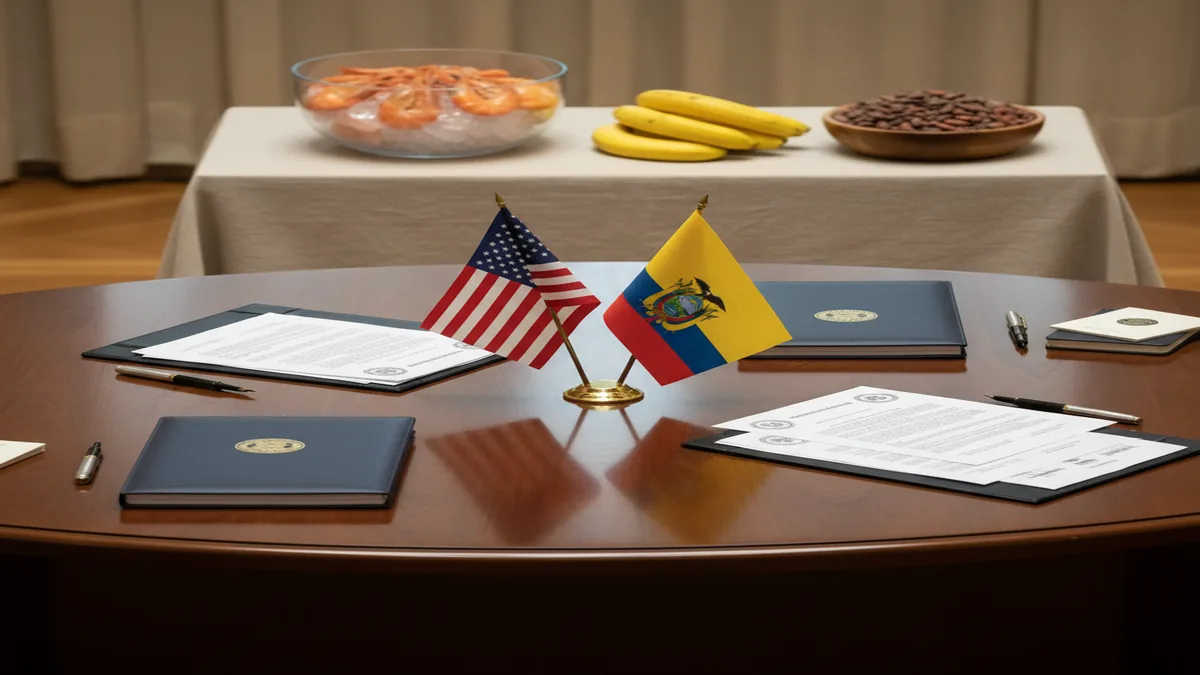
The United States Trade Representative (USTR) and Ecuador's Ministry of Production, Foreign Trade and Investment announced that negotiations for a reciprocal trade agreement have been "substantially concluded," moving the deal toward a formal signing expected in the coming weeks. The agreement would fully eliminate — not merely reduce — the 15% surcharge imposed on Ecuadorian imports since August 2025.
The development represents a significant escalation from the initial framework agreement signed in November 2025, which outlined broad principles but left specific product coverage unresolved.
Products confirmed for tariff elimination
| Product | Current US tariff | New rate | 2025 export value to US |
|---|---|---|---|
| Bananas | 15% surcharge | 0% | ~$980M |
| Raw cacao | 15% surcharge | 0% | ~$620M |
| Roses/cut flowers | 21.8% (15% + 6.8% base) | 0% | ~$580M |
| Heart of palm | 15% surcharge | 0% | ~$45M |
| Mango | 15% surcharge | 0% | ~$35M |
| Pitahaya (dragon fruit) | 15% surcharge | 0% | ~$28M |
Products still seeking inclusion
| Product | 2025 US export value | Industry body | Status |
|---|---|---|---|
| Shrimp | ~$2.0B | CNA | Not confirmed |
| Canned tuna | ~$450M | Cámara de Pesquería | Not confirmed |
| Frozen broccoli | ~$85M | CORPEI | Not confirmed |
| Ceramics | ~$18M | Exporters association | Not confirmed |
| Electrical transformers | ~$12M | Manufacturing sector | Not confirmed |
The shrimp question
The potential exclusion of shrimp has emerged as the most contentious issue. Shrimp represents approximately 30% of all non-petroleum exports to the United States and generates ~$2 billion annually.
José Antonio Camposano, president of the Cámara Nacional de Acuacultura (CNA), stated: "Every agreement the country negotiates must include shrimp, because for every $3 Ecuador exports to the United States, one dollar is shrimp."
The sector currently faces a combined US import burden of 18.78% (15% surcharge + 3.78% countervailing duties), costing the industry an estimated $20 million per month. Exclusion from the trade deal while competitors potentially secure better terms would erode Ecuador's cost advantage against India (26%+ tariff) and Vietnam (46%+).
Trade balance context
| Metric | Value (through Aug 2025) |
|---|---|
| Ecuador exports to US | $4.366B |
| US exports to Ecuador | $1.990B |
| Trade surplus (Ecuador) | $2.376B |
Minister of Production Luis Alberto Jaramillo confirmed that "the proposal from the United States has been to eliminate, not reduce, the surcharge" — a stronger outcome than initially expected. FEDEXPOR president Xavier Rosero called the agreement a "very potent and strategic signal" for Ecuador's trade positioning.
What to watch
The final product list is the critical variable — track whether shrimp and tuna are included before signing. Monitor the formal signing ceremony timeline and whether the deal takes effect immediately or includes a phase-in period. Compare terms against Ecuador's existing trade relationships with the EU and China to assess trade diversion risks. Watch for CNA's direct engagement with USTR on aquaculture product inclusion.
Sources: El Universo, Primicias, USTR
Source
El Universo / Primicias — “Firma con Estados Unidos: 'Todo acuerdo que el país negocie debe incluir al camarón'”
View originalSupport the EcuadorBrief archive.
Research support helps fund review, corrections, and hosting. New publishing is paused.