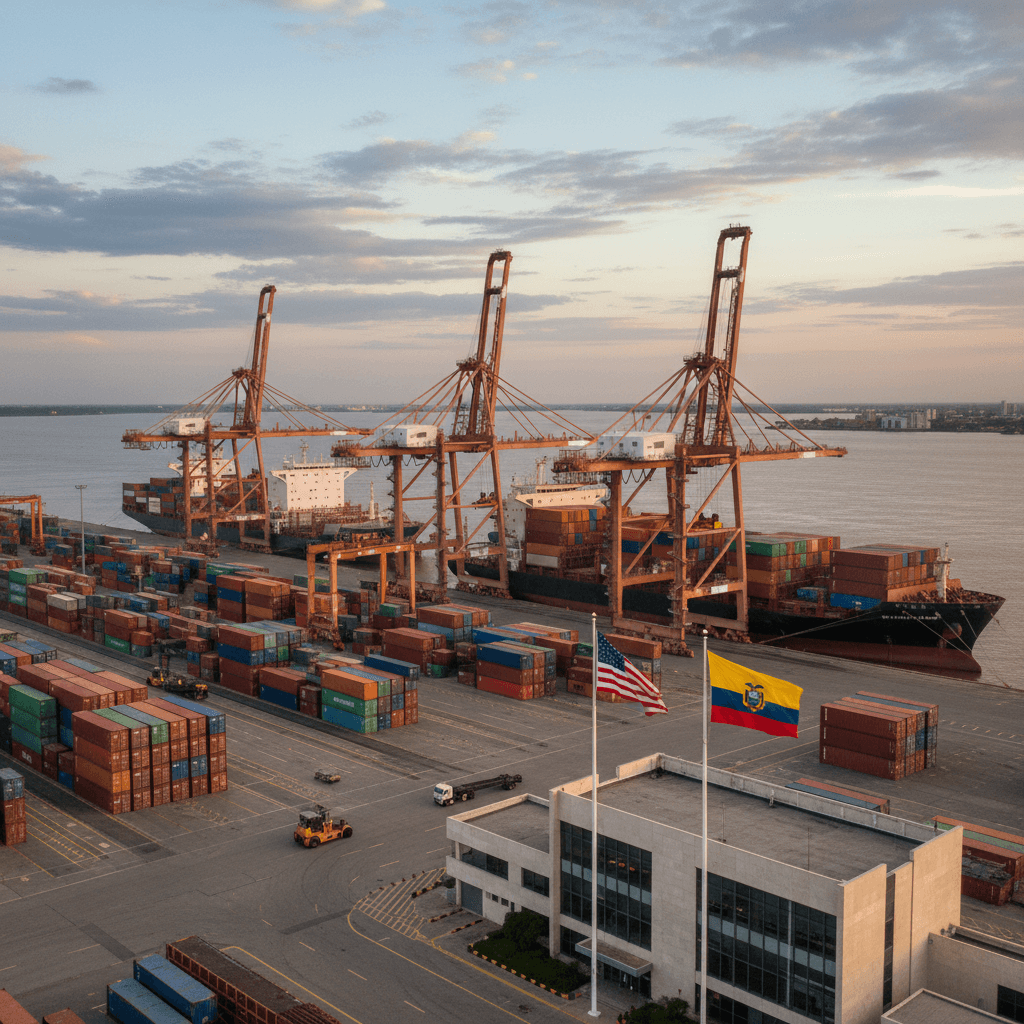
US and Ecuador Sign Reciprocal Trade Framework: Tariff Exemptions for Non-Competing Goods, Market Access for US Machinery and Digital Services

US-Ecuador Reciprocal Trade Framework Takes Shape
The United States and Ecuador signed a Framework for an Agreement on Reciprocal Trade in November 2025, establishing the most comprehensive bilateral trade architecture since the expiration of the Andean Trade Promotion and Drug Eradication Act (ATPDEA) preferences in 2013. The framework sets binding commitments on tariff reduction, agricultural market access, services liberalisation, and digital trade -- and could fundamentally reshape the cost structure for Ecuador's largest commodity exports to the US market.
Framework structure
The agreement operates on a reciprocal basis, with each side making specific commitments:
US commitments to Ecuador:
| Provision | Detail | |---|---|---| | Tariff exemption | Goods that "cannot be grown, mined, or naturally produced in the United States in sufficient quantities" exempt from 15% reciprocal tariff | | Qualifying products | Likely includes shrimp, cacao, bananas, cut flowers, tuna, palm oil | | Implementation | Exemptions take effect upon framework finalisation |
Ecuador commitments to the US:
| Provision | Detail | |---|---|---| | Industrial goods | Reduce/eliminate tariffs on US machinery, health products, ICT equipment, chemicals | | Motor vehicles | Tariff reduction on US-origin vehicles | | Agricultural products | Reduced duties on tree nuts, fresh fruit, wheat, wine, distilled spirits | | Andean Price Band | Eliminate variable tariff on many agricultural products | | Services | No new discriminatory barriers to US services | | Digital trade | Facilitate digital commerce; no discriminatory digital services taxes |
Impact on Ecuador's commodity exports
The tariff exemption clause is the centrepiece for Ecuadorian exporters. The 15% reciprocal tariff imposed by the US in early 2025 has cost the shrimp sector alone an estimated $20 million per month in additional duties. The framework's "non-competing goods" exemption could neutralise this cost for Ecuador's primary commodity exports:
| Product | US imports from Ecuador (2024) | Competing US production? | Likely exempt? |
|---|---|---|---|
| Shrimp | ~$2.1 billion | Minimal (Gulf Coast) | Yes |
| Cacao | ~$800 million | None | Yes |
| Bananas | ~$1.2 billion | Minimal (Hawaii) | Yes |
| Cut flowers | ~$400 million | Limited (California) | Likely |
| Tuna | ~$300 million | Limited | Likely |
The exemption's legal language -- "cannot be grown, mined, or naturally produced in sufficient quantities" -- is deliberately broad and mirrors precedents from the US-Israel FTA and certain AGOA provisions. However, the precise product list has not been finalised, and US domestic producers (particularly Gulf Coast shrimp operators) may lobby for exclusions.
Competitive positioning vs. regional peers
The framework positions Ecuador favourably relative to other Latin American exporters still subject to the full 15% reciprocal tariff:
| Country | US reciprocal tariff | Trade framework status |
|---|---|---|
| Ecuador | 15% (exemptions pending) | Framework signed |
| Colombia | 10% | No framework |
| Peru | 10% | No framework (has FTA) |
| India | 26% | Framework under discussion |
| Vietnam | 46% | Framework under discussion |
For shrimp specifically, Ecuador's competitive position could improve dramatically. India -- Ecuador's primary competitor in the US market -- faces a 26% reciprocal tariff with no framework in place. If Ecuador secures the exemption, the effective tariff differential between Ecuadorian and Indian shrimp entering the US would widen to 26 percentage points -- a transformative cost advantage.
Ecuador's FTA network expands
The US framework adds to Ecuador's rapidly growing web of preferential trade agreements:
| Agreement | Partner | Status | Year |
|---|---|---|---|
| FTA | China | In force | 2024 |
| FTA | Costa Rica | In force | 2024 |
| FTA | Canada | Provisional application | 2025 |
| CEPA | UAE | Signing March 2026 | 2026 |
| Reciprocal Trade Framework | United States | Signed | 2025 |
| Trade Agreement | EU | In force | 2017 |
| FTA | EFTA | In force | 2020 |
| FTA | Chile | In force | 2010 |
| FTA | UK | In force | 2023 |
The breadth of this network is unprecedented for Ecuador, which operated without any bilateral trade agreements as recently as 2016. The US framework is particularly significant because the United States remains Ecuador's second-largest export destination (after China) and the primary market for value-added shrimp products.
Digital trade provisions
The framework includes commitments on digital commerce that are relatively novel for Ecuador:
- No discriminatory digital services taxes -- preventing Ecuador from imposing DSTs that target US technology companies (as several EU nations have done)
- Facilitated digital trade -- streamlined customs procedures for e-commerce shipments
- No data localisation requirements -- US companies will not be required to store data on Ecuadorian servers
These provisions reflect US trade policy priorities under the current administration and align with similar digital trade chapters in recent US agreements with Japan, the UK, and Australia.
What to watch
The product-specific exemption list is the critical outstanding detail -- monitor USTR announcements for the final determination on which Ecuadorian goods qualify as "non-competing." Track Gulf Coast shrimp industry lobbying through the Southern Shrimp Alliance, which has historically opposed tariff relief for imported shrimp. Watch for the framework's impact on Ecuador-India shrimp competition in the US market during Q1 2026 import data releases. The Andean Price Band elimination will be closely watched by US agricultural exporters, particularly wheat and wine producers seeking expanded access to Ecuador's 18-million-person consumer market.
Sources: White House, USTR, Clark Hill
Source
White House / USTR / Clark Hill — "Fact Sheet: The United States and Ecuador Agree to a Framework for Agreement on Reciprocal Trade"
View originalSupport daily Ecuador business intelligence.
Research support funds source monitoring, data checks, editing, publishing, and sector coverage for professionals tracking Ecuador.