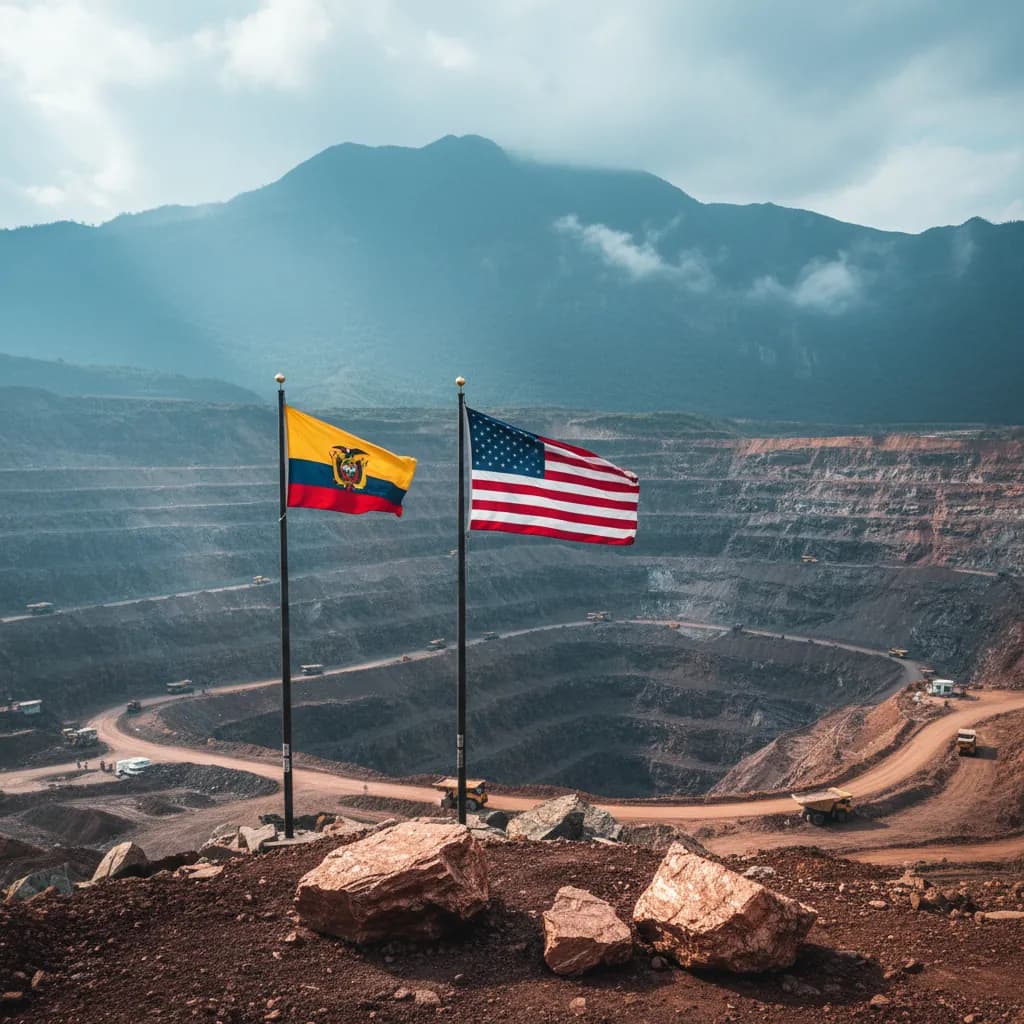
US Formally Designates Ecuador's Rare Earth, Copper, and Gold Reserves as Strategic Minerals at 54-Nation Critical Minerals Ministerial

US Designates Ecuador's Minerals as Strategic
Assistant Secretary of State Caleb Orr announced on February 11, 2026 that the United States has formally recognized Ecuador's rare earth, copper, and gold reserves as strategic minerals under a bilateral framework agreement signed at the 2026 Critical Minerals Ministerial in Washington on February 4.
Orr stated: "Ecuador possesses important and high-quality reserves in the Andean region, especially heavy rare earths, copper and gold."
The agreement was one of 11 bilateral critical minerals frameworks signed at the ministerial, which convened delegations from 54 countries plus the European Commission. Ecuador joins Argentina, Peru, the Philippines, UAE, and others in the strategic minerals partnership.
FORGE Initiative and Project Vault
The designation coincides with the launch of two major US financing mechanisms:
| Initiative | Scale | Purpose |
|---|---|---|
| FORGE (Forum on Resource Geostrategic Engagement) | $30B+ in letters of interest, investments, and loans | Successor to the Minerals Security Partnership; mobilized over 6 months |
| EXIM Project Vault | $10B direct loan facility | Largest EXIM commitment in history — more than double the previous record |
| Private sector investment | ~$2B committed | Participating companies: Clarios, GE Vernova, Western Digital, Boeing, Hartree Partners |
For Ecuador, the practical implications include access to EXIM Bank direct loans, Development Finance Corporation (DFC) investment guarantees, and preferential financing terms for mining infrastructure, processing facilities, and transport logistics.
Ecuador's Mineral Reserves: The Scale
Ecuador sits on the southern extension of the Andean metallic belt — the same geological structure that makes Peru and Chile the world's top copper producers. The country's major mining projects represent a combined resource base of extraordinary scale:
| Project | Primary Metal | Reserves/Resources | Estimated Value | Status |
|---|---|---|---|---|
| Cascabel (Imbabura) | Copper-gold | 10.9M tonnes copper + 23M oz gold | $50B+ in-situ | Acquisition by Jiangxi Copper |
| Cangrejos (El Oro) | Gold-copper | 11.6M oz gold + 1.4B lbs copper | $30B+ at current prices | Acquired by CMOC Group |
| Mirador (Zamora-Chinchipe) | Copper | 3.2M tonnes copper + 3.4M oz gold | $15B+ | Operating (CRCC-Tongguan) |
| Fruta del Norte (Zamora-Chinchipe) | Gold | 5.54M oz gold | $10B+ at current prices | Operating (Lundin Gold) |
| Llurimagua (Imbabura) | Copper-molybdenum | TBD (est. world-class) | $3B+ development cost | ENAMI tender planned 2026 |
Total pipeline capital investment potential: $14+ billion across Cascabel, Warintza, San Carlos, Cangrejos, Mirador II, Loma Larga, Curipamba, and La Plata.
The China Paradox
The US strategic designation faces a fundamental challenge: Chinese state-linked companies already control Ecuador's three largest undeveloped mining projects.
| Company | Project | Deal Value | Status |
|---|---|---|---|
| Jiangxi Copper (China) | Cascabel | $1.2B (SolGold takeover) | Acquisition in progress |
| CMOC Group (China) | Cangrejos | $421M (Lumina Gold acquisition) | Completed June 2025 |
| CRCC-Tongguan (China) | Mirador | $1.4B invested | Operating since 2019 |
Only Lundin Gold's Fruta del Norte (Canadian) and the state-owned ENAMI's Llurimagua project remain outside Chinese control among major deposits.
Orr addressed this tension directly: "These bilateral agreements are not retaliation against China. It's about ensuring resilience in supply chains" and giving partner nations "greater control over those assets."
Ecuador's Cámara de Minería called the agreement "a milestone" for positioning Ecuador as "a reliable supplier in the context of energy transition and global digitalization."
Connection to the US-Ecuador Trade Deal
The minerals framework was signed 9 days before the US and Ecuador substantially concluded negotiations for the Agreement on Reciprocal Trade (ART) on February 13. Together, the agreements create a comprehensive bilateral architecture:
- Trade: Tariff elimination on Ecuadorian exports to the US
- Minerals: Strategic supply chain partnership with financing access
- Security: Expanded military cooperation, surveillance drones, and port monitoring (announced separately)
The three pillars represent a fundamental reorientation of Ecuador's geopolitical positioning — away from the Correa-era non-aligned stance and toward explicit strategic alignment with Washington.
What to Watch
Track whether EXIM Bank or DFC announce specific Ecuador mining project financing — the FORGE framework enables it but individual project approvals require separate review. Monitor Jiangxi Copper's Cascabel acquisition timeline — if completed, China would control the Western Hemisphere's largest undeveloped copper-gold deposit despite the US strategic framework. Watch for ENAMI's Llurimagua tender specifications — the state-owned project may become the test case for whether US financing competes with Chinese offers. Track rare earth exploration permits in the Andean belt — no active rare earth mining exists in Ecuador today, making the designation forward-looking rather than operational.
Sources: US State Department, Primicias, USTR, EXIM Bank, Mining.com
Source
Primicias / US State Department / EXIM Bank — "Estados Unidos reconoce las reservas de tierras raras, cobre y oro de Ecuador"
View originalSupport daily Ecuador business intelligence.
Research support funds source monitoring, data checks, editing, publishing, and sector coverage for professionals tracking Ecuador.
