CAF Invests $450,000 in Ecuador's First National Competitiveness Policy, Signs Technical Cooperation Agreement at Economic Forum 2026 Launch

$450,000 Agreement to Design National Competitiveness Policy
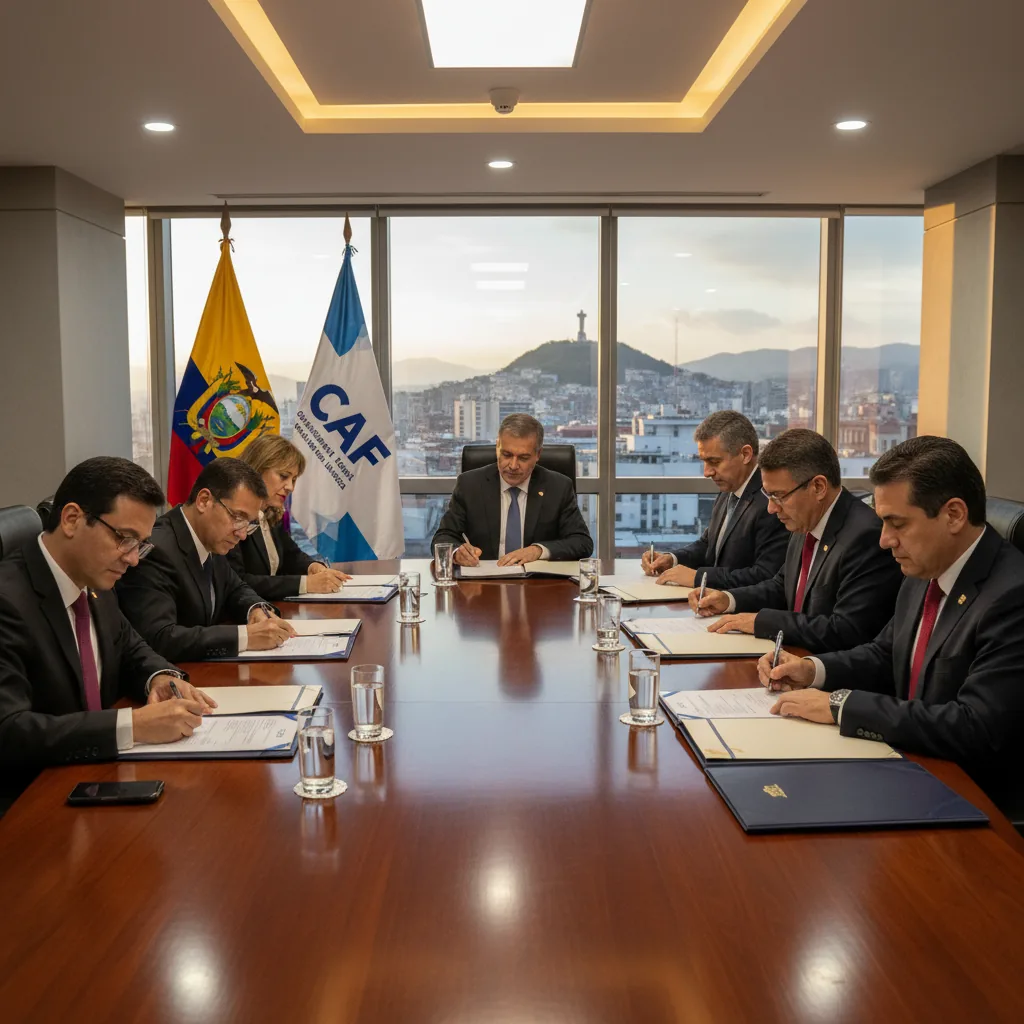
CAF — Development Bank of Latin America and the Caribbean signed a $450,000 non-reimbursable technical cooperation agreement with Ecuador's Ministry of Production, Foreign Trade and Investment to design the country's first comprehensive national competitiveness policy.
The agreement, titled "Towards a New Competitiveness Policy for Ecuador," was signed by CAF Executive President Sergio Díaz-Granados and Minister Luis Alberto Jaramillo at a high-level event in Quito formalizing Ecuador's participation in the II International Economic Forum and Latin America and Caribbean 2026 Business Roundtable.
What the Policy Covers
Minister Jaramillo outlined four pillars of the competitiveness strategy:
| Pillar | Focus |
|---|---|
| Sector modernization | Technification and upgrading of productive sectors |
| Innovative investment | Attracting and channeling investment into high-value activities |
| Global value chains | Integrating value-added Ecuadorian products into international supply chains |
| Institutional continuity | Designing policies that transcend individual government terms |
The $450,000 in non-reimbursable resources will generate technical capacity within the Ministry for developing public policies on productivity, competitiveness, and sustainability. CAF will provide methodology, benchmarking data, and advisory support drawn from similar competitiveness policy engagements across the region.
CAF Forum 2026: The Larger Context
The Ecuador agreement was formalized as part of CAF's broader International Economic Forum 2026, held January 28-30 in Panama City:
| Metric | Scale |
|---|---|
| Attendees | 6,500+ leaders |
| Countries represented | 70 |
| Event | Largest regional economic gathering in recent years |
| Focus areas | Infrastructure modernization, green transition, digital transformation, energy transition, public-private partnerships |
Díaz-Granados described the Forum as demonstrating that "Latin America and the Caribbean claim a global space of their own" in shaping economic policy, moving beyond reactive positions to proactive development strategies.
Key trade and business leaders from Ecuador's private sector participated in the Quito launch event, expressing "strategic commitment to the pillars of productivity, competitiveness and sustainability."
Ecuador's Competitiveness Gap
The agreement responds to Ecuador's persistent competitiveness challenges:
| Indicator | Ecuador | Regional Average |
|---|---|---|
| Global Competitiveness Index | 90th of 141 economies | ~70th (LatAm average) |
| Ease of Doing Business | 129th (World Bank, last ranking) | ~100th (LatAm) |
| Innovation Index | 98th (WIPO 2024) | ~75th (LatAm) |
| Logistics Performance | Below LatAm average | — |
Ecuador's dollarized economy eliminates monetary policy flexibility, making structural competitiveness improvements — logistics, regulation, workforce skills, technology adoption — the primary levers for growth.
Connection to Broader Reform Agenda
The CAF competitiveness agreement aligns with several concurrent policy initiatives:
- US-Ecuador Agreement on Reciprocal Trade (ART): Concluded February 15, 2026 — tariff elimination on $3.2 billion in non-petroleum exports requires Ecuadorian producers to meet US market standards
- US Strategic Minerals Framework: Signed February 4, 2026 — opens EXIM Bank and DFC financing for mining infrastructure
- IMF Extended Fund Facility: Ongoing program requiring fiscal discipline and structural reforms
- 2025-2030 Energy Expansion Plan: $2.43 billion investment in renewables and grid modernization
Together, these initiatives represent a multi-track modernization push — trade access (ART), resource development (minerals), fiscal stability (IMF), energy security (expansion plan), and now institutional capacity (CAF competitiveness policy).
Participating Officials
Beyond Díaz-Granados and Jaramillo, the Quito event included:
- Sariha Moya, Minister of Economy and Finance
- Trade association presidents from multiple sectors
- Private sector leaders representing commodities, manufacturing, and services
What to Watch
Track the competitiveness policy draft timeline — the $450,000 allocation suggests a 12-18 month design phase before implementation. Monitor whether the policy includes sector-specific benchmarks or remains high-level. Watch for private sector input mechanisms — the emphasis on transcending government terms suggests an attempt to build consensus across political parties. Track whether the policy integrates with Ecuador's trade agreement obligations under the ART and existing EU FTA, which impose compliance standards that require competitiveness improvements.
Sources: CAF, Ministry of Production, Bloomberg Línea
Source
CAF / Ministry of Production — “Ecuador se suma al Foro Económico Internacional 2026 y firma acuerdo de cooperación técnica con CAF”
View originalSupport the EcuadorBrief archive.
Research support helps fund review, corrections, and hosting. New publishing is paused.