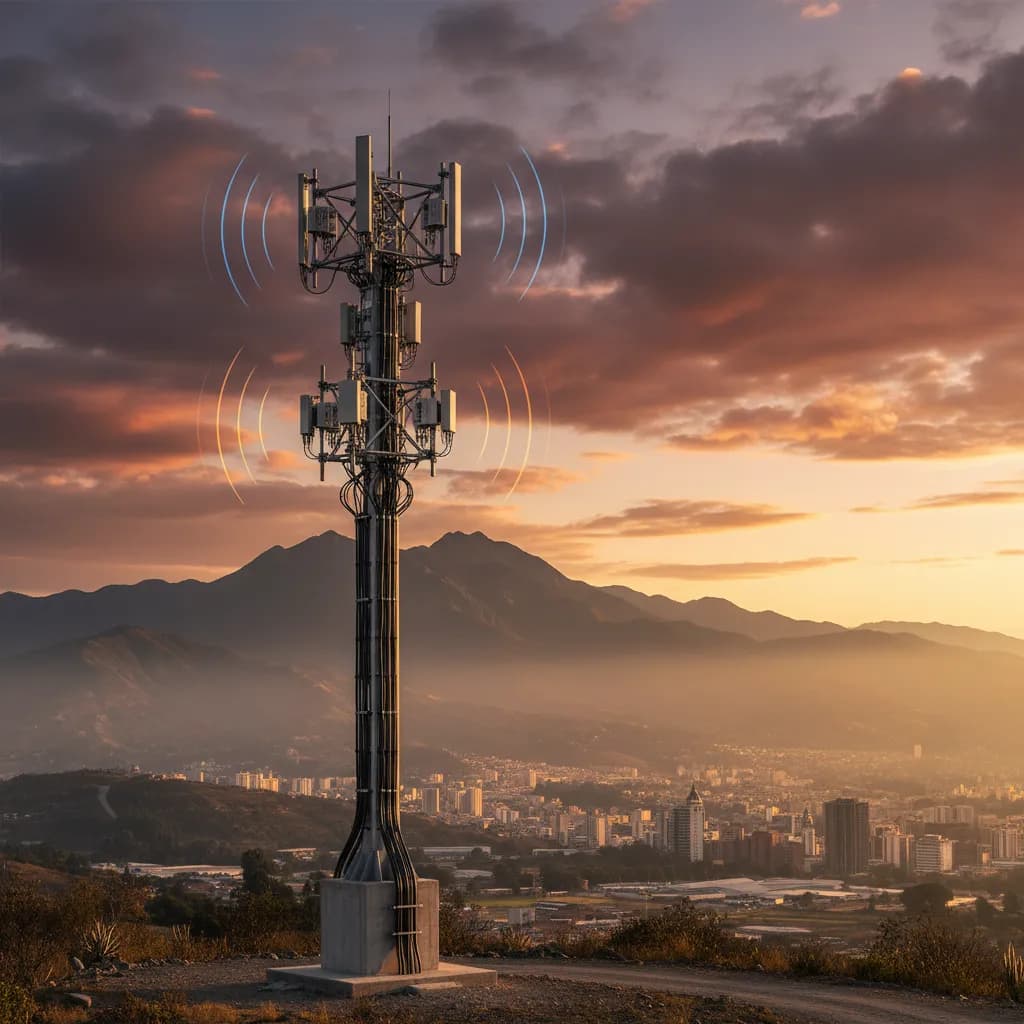
CNT and Nokia Launch Ecuador's First Commercial 5G Network With 422 Base Stations, National Coverage Targeted by Mid-2026

Ecuador's First 5G Network Goes Live
CNT (Corporacion Nacional de Telecomunicaciones) — Ecuador's state-owned telecom — has launched the country's first commercial 5G network in partnership with Nokia, deploying 422 base stations across six major cities.
The network operates on the N78 band (3.5 GHz), delivering speeds of up to 1.5 Gbps — approximately 10-20 times faster than Ecuador's current 4G LTE average of 75-100 Mbps.
Rollout Plan
| Phase | Cities | Base Stations | Timeline |
|---|---|---|---|
| Phase 1 (Active) | Quito, Guayaquil | Initial deployment | Q4 2025 |
| Phase 2 (Underway) | Manta | 7 base stations | Feb 2026 |
| Phase 3 | Cuenca, Ambato, Santo Domingo | Additional deployment | Q1-Q2 2026 |
| National coverage | All major cities | 422 total stations | Mid-2026 |
Technology Specifications
| Metric | Value | |---|---|---| | Spectrum band | N78 (3.5 GHz) | | Peak download speed | 1.5 Gbps | | Latency | <10 milliseconds | | Base stations planned | 422 | | Equipment provider | Nokia | | Network architecture | Standalone 5G (SA) |
The deployment uses standalone 5G architecture — the most advanced configuration — rather than the non-standalone (NSA) approach that some operators adopt as a transitional step. This positions CNT to offer the full range of 5G capabilities including network slicing, massive IoT connectivity, and ultra-low latency applications.
Private Operators to Follow
Claro (America Movil) and Movistar (Telefonica) — Ecuador's two major private mobile operators — are expected to begin their own 5G deployments in Q1 2026, creating a three-operator competitive landscape:
| Operator | Ownership | 5G Status | Market Share (Mobile) |
|---|---|---|---|
| CNT | State-owned | Live | ~20% |
| Claro | America Movil (Mexico) | Q1 2026 deployment | ~55% |
| Movistar | Telefonica (Spain) | Q1 2026 deployment | ~25% |
Claro's dominant 55% market share means its 5G rollout will determine the pace of mass adoption. The company's parent, America Movil, has deployed 5G networks across Mexico, Brazil, Colombia, and Chile.
Ecuador's Digital Infrastructure Context
| Metric | Value | |---|---|---| | Internet penetration | 70%+ | | Smartphone penetration | 65%+ | | Mobile subscriptions | ~16 million | | Fixed broadband subscribers | ~2.5 million | | Average mobile speed (4G) | 75-100 Mbps | | Average fixed broadband speed | 40-60 Mbps |
AI Strategy Unveiled in Dubai
Telecom Minister Ivan Kury presented Ecuador's First AI Strategy at the World Governments Summit 2026 in Dubai, featuring 21 action axes organized around:
- Regulation — Legal framework for AI deployment and data governance
- Education — AI curriculum integration and scholarship programs
- Technological free trade zones — Special economic zones for AI R&D investment
- Digital government — AI-powered public service delivery
The strategy positions Ecuador among the first Latin American countries to adopt a comprehensive national AI policy, complementing the 5G infrastructure buildout with a regulatory and educational framework.
Economic Impact Potential
5G connectivity enables several high-value applications relevant to Ecuador's economy:
| Application | Sector Impact |
|---|---|
| Precision agriculture | Remote monitoring of shrimp farms, banana plantations |
| Port automation | DP World Posorja container tracking and logistics |
| Mining telemetry | Real-time monitoring of Fruta del Norte, Mirador operations |
| Telemedicine | Rural healthcare delivery in the Sierra and Oriente |
| Smart cities | Quito Metro integration, traffic management |
What to Watch
Track Claro's Q1 2026 5G launch — as the dominant operator, its deployment timeline and pricing will determine mass adoption speed. Monitor spectrum auctions — additional spectrum allocation for 5G services could attract new entrants or expand existing operator capacity. Watch for enterprise 5G applications — early adoption by mining, port, and agriculture companies will signal commercial viability beyond consumer use. Track the AI Strategy implementation — the technological free trade zone concept could attract international technology investment if regulatory details are competitive.
Sources: Nokia, BNamericas, DPL News, MINTEL
Source
Nokia / BNamericas / DPL News — “Nokia and CNT launch Ecuador's first 5G network”
View originalSupport the EcuadorBrief archive.
Research support helps fund review, corrections, and hosting. New publishing is paused.