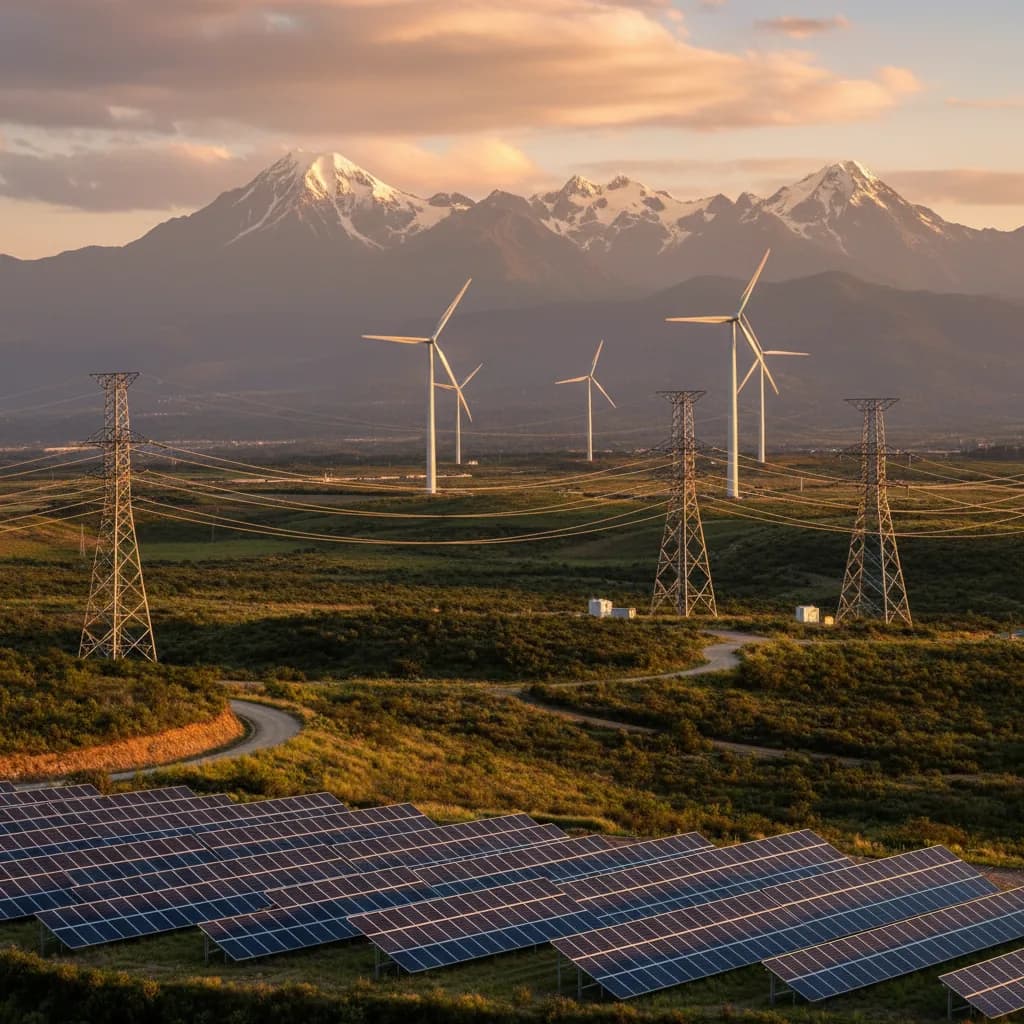
Ecuador Commits $2.43 Billion to 23 Power Projects Adding 1,471 MW by 2030, With Solar Accounting for 963 MW and $913 Million After Worst Energy Crisis in Decades

$2.43 Billion for 23 New Power Projects
Ecuador's government unveiled its 2025-2030 electric power expansion plan, committing $2.43 billion across 23 projects to add 1,471 MW of new renewable energy capacity — the largest power infrastructure investment in the country's history.
The plan responds directly to the 2024 energy crisis, when prolonged drought caused daily blackouts of up to 14 hours across the country. The Central Bank of Ecuador estimated economic losses of approximately $2 billion for 2024, driven by the nation's 78% dependence on hydropower for electricity generation.
Capacity Breakdown by Technology
| Technology | New Capacity (MW) | Investment | Share of Plan |
|---|---|---|---|
| Solar | 963 MW | $913 million | 65.5% |
| Hydroelectric | ~300 MW | ~$800 million | 20.4% |
| Wind | ~130 MW | ~$450 million | 8.8% |
| Geothermal | ~78 MW | ~$270 million | 5.3% |
| Total | 1,471 MW | $2.43 billion | 100% |
The solar-first strategy represents a fundamental shift for Ecuador, which historically invested almost exclusively in large hydroelectric facilities. Solar capacity alone would exceed the country's current combined wind (71 MW) and solar (29 MW) installed base by nearly 10 times.
Why the Pivot Away from Hydropower
Ecuador's electricity sector entered the crisis with a generation mix heavily tilted toward water:
| Source | Installed Capacity | Share |
|---|---|---|
| Hydropower | 5,419 MW | 58.6% of total capacity |
| Thermal (fossil fuel) | 3,569 MW | 38.6% |
| Biomass | 1,550 MW | Intermittent |
| Wind | 71 MW | 0.8% |
| Solar | 29 MW | 0.3% |
| Total | 9,255 MW | — |
Two structural failures compounded the drought:
1. Coca Codo Sinclair (CCS): The 1,500 MW Chinese-built hydroelectric plant — representing 30% of Ecuador's total generation capacity — suffered ongoing operational failures throughout 2024. The facility, financed through Chinese sovereign lending, has been plagued by construction defects, erosion, and capacity shortfalls since its 2016 commissioning.
2. Climate vulnerability: Ecuador's hydro-dependent grid failed to account for increasing drought severity linked to El Niño-Southern Oscillation (ENSO) patterns and long-term climate change. The 2024 drought was the worst in over 60 years.
IDB $1 Billion Credit Line for Grid Modernization
The Inter-American Development Bank (IDB) approved a $1 billion Conditional Credit Line for Investment Projects (CCLIP) to finance complementary grid infrastructure:
| Component | Scope |
|---|---|
| Transmission lines | 700+ km of new high-voltage infrastructure |
| Rural electrification | 5,600 new households connected in the Amazon by 2031 |
| Grid resilience | Substation upgrades, smart grid integration |
| Private sector leverage | $77 million IDB guarantee backing 12 investment projects adding 820+ MW |
The IDB guarantee alone is expected to mobilize approximately $1 billion in private investment across the 12 projects.
Emergency Measures Already Underway
While the 2025-2030 plan targets medium-term expansion, the government deployed emergency capacity in 2025:
| Project | Capacity | Status |
|---|---|---|
| Three rental barges | 300 MW | Operational |
| Salitral | 100 MW | Commissioned |
| Quevedo | 50 MW | Commissioned |
| Esmeralda | 91 MW | Commissioned |
| Toachi Pilatón | 254 MW | Online after 6 years of delays |
Executive Decree 32 (June 2025) requires high-voltage consumers to install on-site generation covering their full demand by December 18, 2026, with surplus power sellable to the grid — effectively mandating distributed generation for industrial consumers.
Private Sector Distributed Generation
Beyond the state plan, Ecuador's Ministry of Environment and Energy authorized private companies to develop 643 MW of distributed generation projects using renewable sources, including solar arrays and small hydroelectric plants. These self-generation projects complement the centralized expansion plan.
Demand Growth: The Race Against Time
Ecuador's power demand is growing at approximately 360 MW per year, with peak demand reaching 5,110 MW in May 2025. The 1,471 MW expansion covers roughly four years of demand growth — meaning additional projects beyond this plan will be needed before 2030.
| Year | Projected Peak Demand | Capacity Gap (without expansion) |
|---|---|---|
| 2025 | 5,110 MW | Tight balance |
| 2027 | ~5,830 MW | ~575 MW shortfall |
| 2030 | ~6,910 MW | ~1,655 MW shortfall |
Investment Opportunities
The expansion plan creates opportunities across the energy value chain:
- Solar EPC contracts: 963 MW across multiple sites, potentially Ecuador's largest solar procurement
- Transmission infrastructure: 700+ km of new lines requires engineering, equipment, and construction services
- Grid modernization: Smart grid, SCADA systems, battery storage integration
- Geothermal exploration: Ecuador's first utility-scale geothermal development
- Wind farm development: Sites in Loja and coastal provinces
What to Watch
Track specific project tender announcements — the 23 projects will likely be bid through CELEC (state utility) and the Energy Ministry over 2026-2027. Monitor Coca Codo Sinclair rehabilitation — the plant's operational recovery (or continued failure) will determine how urgently new capacity is needed. Watch for solar panel supply chain agreements — 963 MW of solar requires massive panel procurement, likely from Chinese manufacturers, creating interesting supply chain dynamics alongside the US strategic minerals partnership. Track IDB disbursement timeline — the $1 billion CCLIP approval does not guarantee rapid deployment.
Sources: Ministry of Energy, IDB, New Energy Events, Trade.gov, RenewablesNow
Source
New Energy Events / IDB / Trade.gov / RenewablesNow — "Ecuador unveils US$2.43 billion energy expansion plan with 1.47 GW of renewables"
View originalSupport daily Ecuador business intelligence.
Research support funds source monitoring, data checks, editing, publishing, and sector coverage for professionals tracking Ecuador.