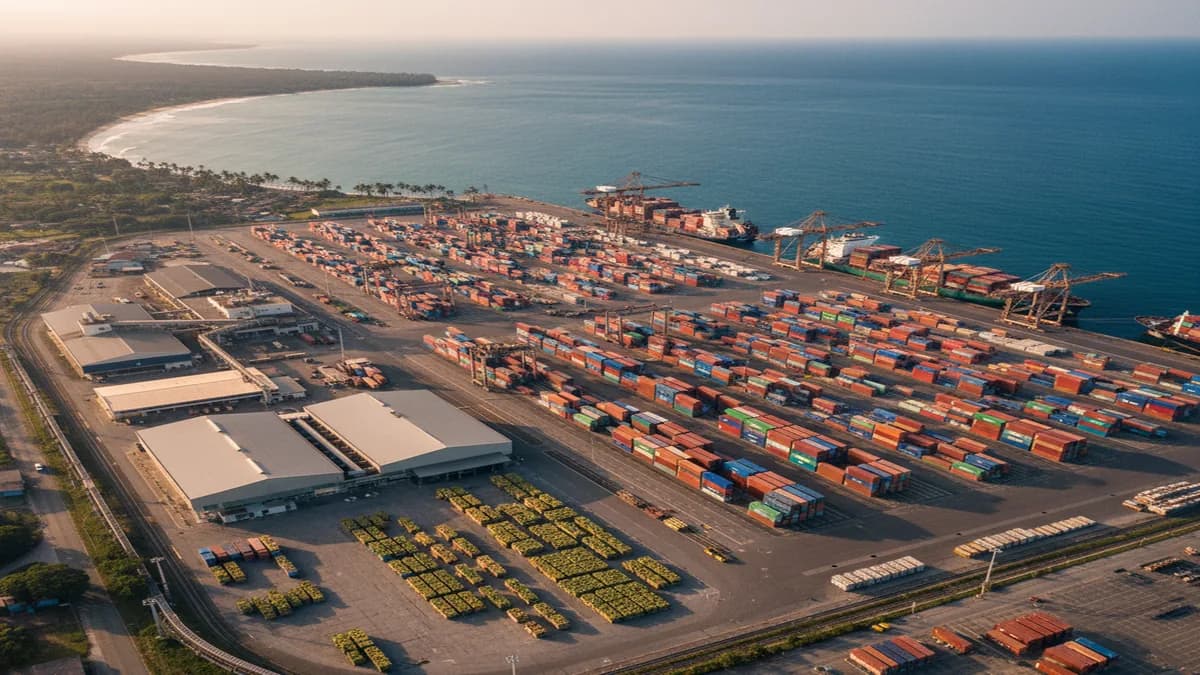
Construction Sector Forecast: 4.6% Annual Growth Through 2029, $7.5B PPP Pipeline

Growth Forecast
Research & Markets projects that Ecuador's construction sector will grow at an average rate of 4.6% annually from 2026 through 2029, building on an estimated 3.8% real growth in 2025. The sector's expansion is driven by a convergence of public infrastructure investment, PPP-enabled mega-projects, and energy sector capital expenditure tied to the mining reform law.
| Year | Construction Growth (proj.) | Key Driver |
|---|---|---|
| 2025 | 3.8% (est.) | Post-crisis recovery, housing demand |
| 2026 | 4.2% | Ministry of Infrastructure plan, PPP launches |
| 2027 | 4.8% | Mining infrastructure, energy projects |
| 2028 | 4.9% | PPP pipeline ramp-up, housing completions |
| 2029 | 4.5% | Sustained investment, maintenance cycle |
| Average 2026-2029 | 4.6% | -- |
Public Investment Plan — 2026
The Ministry of Infrastructure has committed $407 million in its 2026 Annual Investment Plan, allocated across multiple priority categories:
| Category | Allocation | Key Projects |
|---|---|---|
| Road infrastructure | $185M | Pan-American Highway rehabilitation, rural connectivity |
| Social housing | $58M | "Creamos Vivienda" program |
| Urban infrastructure | $72M | Water systems, sanitation, public spaces |
| Bridge and viaduct | $52M | Fifth Bridge Guayaquil, provincial crossings |
| Institutional | $40M | Schools, health facilities, government buildings |
| Total | $407M | -- |
Creamos Vivienda
The "Creamos Vivienda" housing program — the Noboa administration's flagship social housing initiative — has a 2026 budget of $58 million. The program targets the national housing deficit, estimated at approximately 1.2 million units by MIDUVI (Ministry of Urban Development and Housing):
- Units targeted (2026): ~4,500 new homes
- Subsidy range: $6,000-$12,000 per unit depending on income tier
- Eligible income: Households earning below $800/month
- Geographic priority: Guayaquil, Quito, Cuenca, Santo Domingo
Fifth Bridge — Guayaquil
The Fifth Bridge over the Daule River in Guayaquil represents a critical urban infrastructure project with a budget of $33 million:
| Parameter | Detail |
|---|---|
| Location | Guayaquil, spanning Daule River |
| Budget | $33 million |
| Length | ~1.2 km (bridge and approaches) |
| Lanes | 6 (3 per direction) |
| Timeline | Construction start H2 2026, completion 2028 |
| Purpose | Relieve congestion on existing Guayaquil-Daule crossings; connect northern development zones |
PPP Pipeline — $7.5 Billion
Ecuador has published $7.5 billion in public-private partnership investment opportunities on the SOURCE infrastructure transparency platform, a tool developed by the Sustainable Infrastructure Foundation and endorsed by the G20. The pipeline spans multiple sectors:
| Sector | PPP Value | Major Projects |
|---|---|---|
| Energy | $3.2B | Renewable generation, grid modernization, mining power |
| Transport | $2.1B | Highway concessions, port expansion, airport upgrades |
| Water/sanitation | $1.0B | Treatment plants, distribution networks |
| Social infrastructure | $0.7B | Hospitals, education facilities |
| Digital | $0.5B | Broadband, data centers |
| Total | $7.5B | -- |
The PPP framework was strengthened under the Organic Law for Public-Private Partnerships (updated 2025), which streamlined approval timelines and established a dedicated PPP Secretariat within the Ministry of Economy and Finance.
Sector Drivers
Three structural forces underpin the construction growth forecast:
1. Energy Infrastructure The 2024 power crisis — which cost the economy an estimated $3-4 billion — has created urgent demand for energy generation and transmission infrastructure. Solar, wind, and gas-fired projects in the pipeline will require significant civil works.
2. Mining Cluster Development The mining reform law (effective March 2, 2026) is expected to trigger $10-15 billion in mining investment over the next decade. Each major mining project requires associated infrastructure: access roads, worker housing, processing facilities, and power generation.
3. Housing Deficit Ecuador's 1.2 million unit housing deficit, combined with urbanization rates exceeding 65%, creates sustained demand for residential construction. Internal migration driven by rural insecurity has accelerated housing demand in Guayaquil, Quito, and Cuenca.
Regional Breakdown
| Region | Construction Share | Growth Driver |
|---|---|---|
| Guayaquil / Guayas | ~35% | Port infrastructure, housing, Fifth Bridge |
| Quito / Pichincha | ~28% | Metro completion, institutional, road |
| Cuenca / Azuay | ~8% | Housing, water infrastructure |
| Mining provinces (Zamora, Imbabura) | ~12% | Mining-related civil works |
| Coastal (Manabí, Esmeraldas) | ~10% | Reconstruction, port, agriculture |
| Other | ~7% | Mixed |
What to Watch
- PPP conversion rate — the critical metric is how much of the $7.5 billion published pipeline converts into awarded and financed projects; historically, Ecuador's PPP execution rate has been below 20%
- Construction materials costs — cement, steel, and aggregate price inflation could erode margins; the Colombia trade dispute adds supply chain risk for imported construction inputs
- Fifth Bridge timeline — whether the Guayaquil project proceeds on the announced H2 2026 construction start, which would signal improved municipal-national government coordination
- Mining infrastructure tenders — the first construction contracts associated with Llurimagua and other concessions will test the sector's capacity to absorb large-scale industrial projects
- Creamos Vivienda delivery — unit completion rates against the 4,500 target will indicate whether the housing program can scale to address the structural deficit
Support the EcuadorBrief archive.
Research support helps fund review, corrections, and hosting. New publishing is paused.