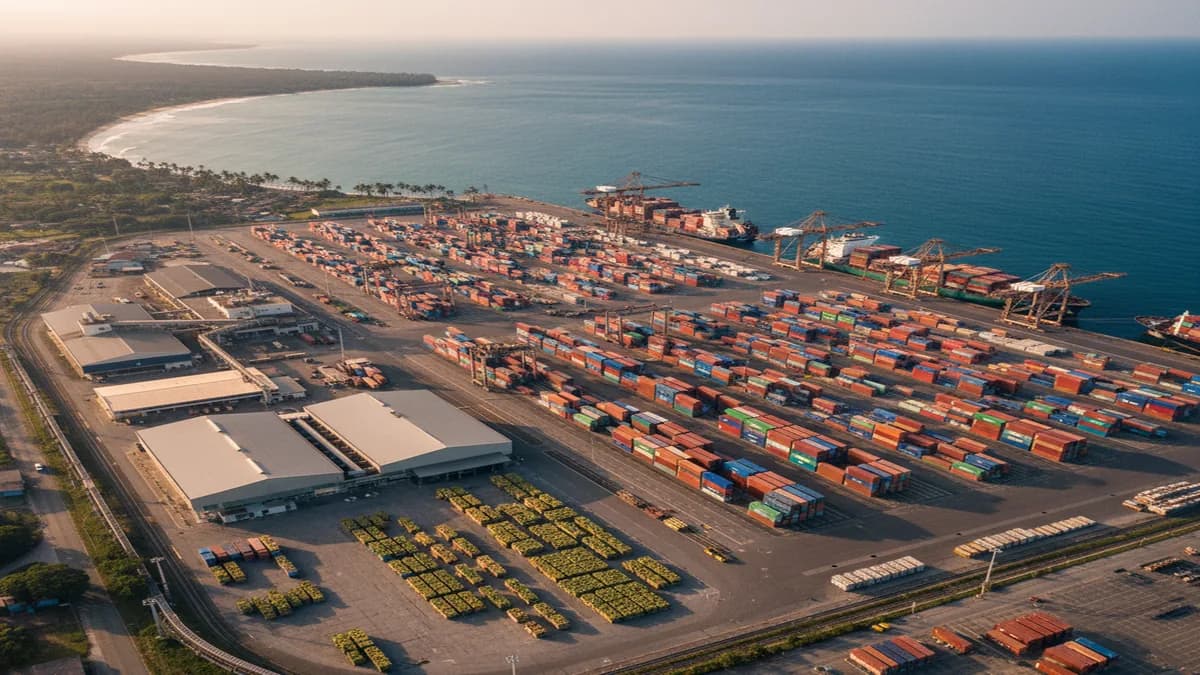
Ecuador Shrimp Exports Hit $7.5B in 2025; January 2026 Volumes Up 23% YoY

2025 Full-Year Performance
Ecuador's shrimp sector posted its strongest year on record:
| Metric | 2024 | 2025 | Change |
|---|---|---|---|
| Export value | $6.06B | $7.47B | +23.2% |
| Export volume | ~1.08M MT | ~1.25M MT (est.) | +16% |
| Avg. price/kg | $5.61 | $5.98 | +6.6% |
Shrimp has now surpassed petroleum as Ecuador's single largest export category — a structural shift in the country's export composition that has been building for a decade.
January 2026: Momentum Continues
January 2026 data shows the trend is accelerating:
- Volume: 125,200 tonnes (+23% YoY)
- Value: Not yet officially reported, but consistent with the 2025 price trajectory
- Top destinations: China (49.5%), Europe (~20%), United States (~12%)
Market Structure
China dominance: China absorbs nearly half of Ecuador's shrimp output. This concentration creates:
- Revenue stability — Chinese demand has been consistent
- Concentration risk — any Chinese import policy change would have outsized impact
- Pricing power — large Chinese importers can negotiate volume discounts
US market: The recently signed US-Ecuador ART did not explicitly address shrimp tariffs, leaving the US market's tariff treatment uncertain. Shrimp is Ecuador's second-largest export to the US after bananas.
EU market: Ecuador benefits from the EU Multi-Party Trade Agreement, which provides preferential access for aquaculture products.
Production Drivers
The sustained growth is driven by technification — the industry's shift from extensive to intensive and semi-intensive farming:
- Genetics: Improved broodstock with faster growth rates and disease resistance
- Feed efficiency: Better conversion ratios reducing cost per kilogram
- Biosecurity: Post-pandemic protocols reducing early mortality events
- Farm density: Higher stocking densities enabled by aeration and water quality management
- Processing capacity: Expanded value-added processing (cooked, peeled, breaded) improving margins
Industry association CNA (Cámara Nacional de Acuacultura) projects a potential 15% further increase in 2026 production.
Sector Risks
- Disease outbreak: White spot syndrome and early mortality syndrome remain latent threats
- China trade dependency: Any Chinese import restriction or tariff would immediately compress margins
- Environmental regulation: Growing pressure on mangrove restoration and effluent standards
- US tariff uncertainty: If shrimp is eventually subject to reciprocal tariffs, the US market ($900M+) would be significantly affected
- Ecuador-Colombia tariffs: Colombia's retaliatory 50% tariffs affect Ecuadorian canned seafood exports
What to Watch
- Q1 2026 export data (due April) — will confirm whether the January surge is sustained
- US-Ecuador ART implementation — specifically whether shrimp gains explicit tariff relief
- Chinese import volumes — any softening would be a leading indicator of sector stress
- CNA production estimates — the 15% growth target implies ~1.44M MT, which would set a new global record
Sources: Undercurrent News, SeafoodSource, WeAreAquaculture
Source
Undercurrent News — “Ecuador shrimp exports surge 23% in January as strong 2025 momentum carries into new year”
View originalReport an article problem
Tell us what seems incorrect or outdated. Email is optional.
For business readers
Need a focused answer to an Ecuador business question?
Request a separately scoped 30-minute research consult with a written summary. A request does not update or verify this archived article. This is business research context, not legal, tax, or investment advice.
Request a research consultSupport the EcuadorBrief archive.
Research support helps fund source monitoring, corrections, and hosting.