Ecuador Shrimp Exports Smash Record at 1.39 Million Metric Tons in 2025, Industry Projects 15% Growth for 2026

Ecuador Shrimp: 1.39M Metric Tons in 2025
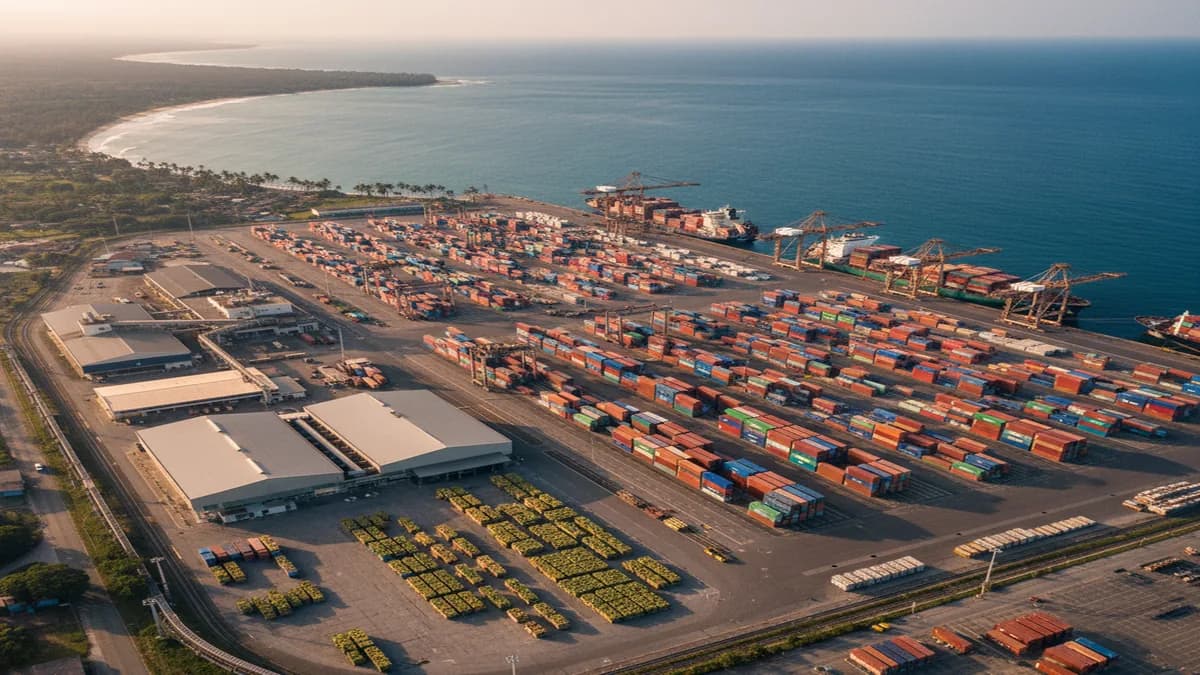
Ecuador's shrimp sector delivered a "remarkable year" in 2025, with exports reaching a record 1.39 million metric tons valued at approximately $7.5 billion, according to trade data compiled by Undercurrent News and the Cámara Nacional de Acuacultura (CNA). The performance represents a 15% year-on-year increase and breaks decisively through the plateau that characterised 2024, when growth stalled amid global trade disruptions and soft Chinese demand.
Shrimp is now Ecuador's largest non-oil export and the single most important source of foreign exchange for the dollarised economy.
2025 performance in context
| Metric | 2025 | 2024 | 2023 | Change (YoY) |
|---|---|---|---|---|
| Volume (MT) | 1,390,000 | ~1,210,000 | ~1,150,000 | +15% |
| Value (est.) | ~$7.5 billion | ~$6.8 billion | ~$7.1 billion | +10% |
| Avg. price/kg | ~$5.40 | ~$5.60 | ~$6.20 | -4% |
The apparent paradox -- volume up 15%, value up only 10% -- reflects the continued softening of global shrimp prices from the 2022-23 peaks. Average export prices declined approximately 4% year-on-year as increased global supply (from Ecuador, India, and Vietnam) outpaced demand growth. However, the volume surge more than compensated, delivering the highest absolute revenue in the sector's history.
First-half momentum carried through
The record year was front-loaded: H1 2025 alone saw 719,153 MT shipped, a 17% year-on-year increase that set the pace for the full-year result.
| Half | Volume (MT) | YoY growth |
|---|---|---|
| H1 2025 | 719,153 | +17% |
| H2 2025 | ~670,847 | +13% (est.) |
| Full year 2025 | 1,390,000 | +15% |
Market distribution: China dominant, US stable
China's share of Ecuadorian shrimp exports consolidated at 48%, making it by far the single largest destination. The US held steady as the second market, while European demand showed modest growth:
| Market | Share of 2025 exports | Trend | Key dynamics |
|---|---|---|---|
| China | 48.18% | Stable-to-growing | Post-COVID foodservice recovery; e-commerce cold chain expansion |
| United States | 19.42% | Stable | 15% reciprocal tariff headwind; trade framework may provide relief |
| Europe (combined) | 22.89% | Slight growth | EU sustainability requirements; ESG-certified product demand |
| Other Asia | ~5% | Growing | South Korea, Japan FTA pipeline |
| Rest of world | ~4.5% | Mixed | UAE CEPA opportunity |
China's dominance presents both opportunity and concentration risk. The 48% share means Ecuadorian shrimp is heavily exposed to Chinese economic conditions, consumer sentiment, and import policy. The ongoing US-China trade tensions could indirectly benefit Ecuador if Chinese buyers diversify away from US protein sources -- but could also create volatility if Chinese demand softens during an economic slowdown.
Technification: the growth engine
The industry's 10-15% growth projection for 2026 is underpinned by the accelerating technification of Ecuador's shrimp farms -- a shift from extensive (low-density, large-area) to intensive (high-density, technology-driven) production methods:
| Method | Density | Yield | Technology |
|---|---|---|---|
| Extensive (traditional) | 10-15 shrimp/m² | 1,500-2,500 kg/ha/cycle | Minimal aeration, natural feeding |
| Semi-intensive | 30-50 shrimp/m² | 4,000-6,000 kg/ha/cycle | Mechanical aeration, supplemental feed |
| Intensive | 80-150 shrimp/m² | 10,000-20,000 kg/ha/cycle | Biofloc systems, 24/7 monitoring, automated feeding |
Ecuador has historically operated primarily in the extensive range, leveraging its natural advantages -- warm Pacific waters, extensive mangrove-adjacent coastline, and low labour costs. The shift toward semi-intensive and intensive methods is dramatically increasing per-hectare yields without requiring proportional land expansion.
Key technification investments include:
- Biofloc systems that recycle waste as microbial protein, reducing feed costs by 15-20%
- IoT-connected monitoring for water quality, dissolved oxygen, and feeding optimisation
- Genetic selection programmes producing faster-growing, disease-resistant broodstock
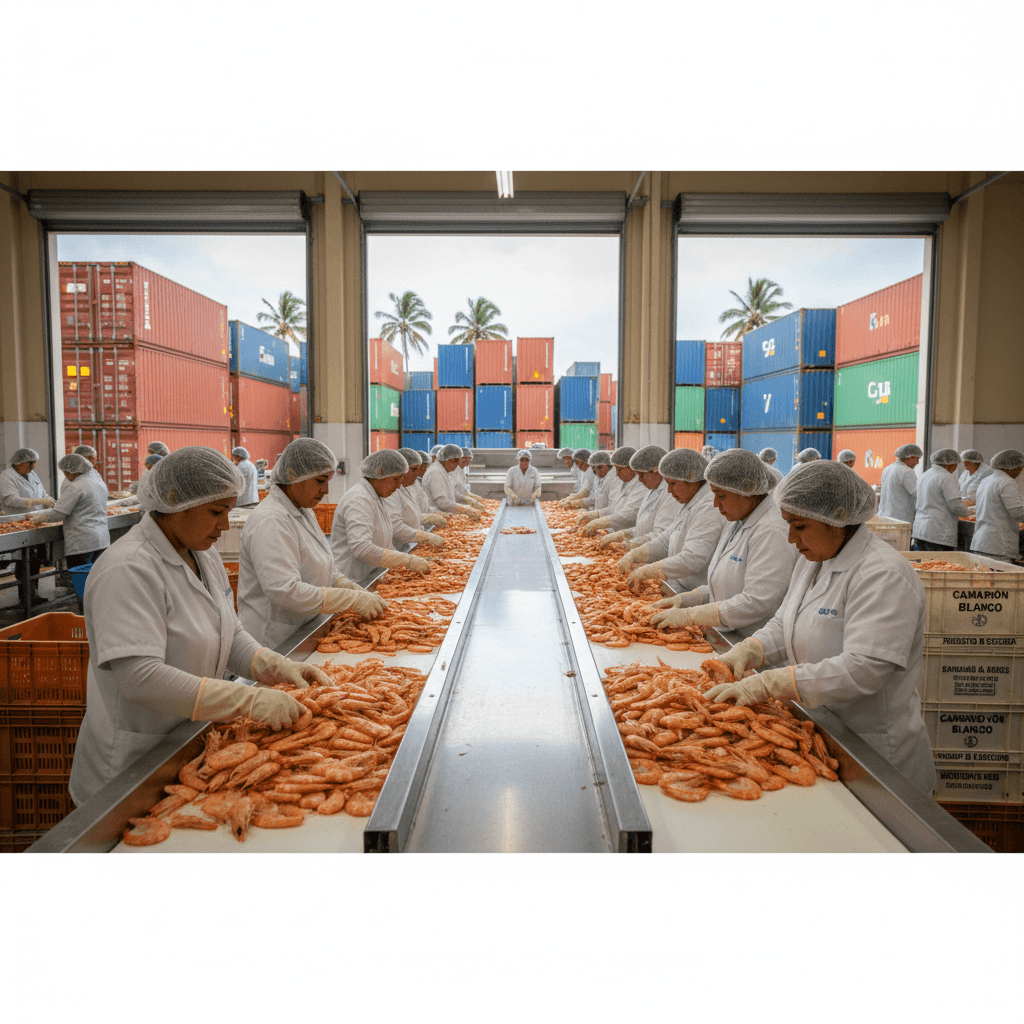
- Post-harvest processing expansion, moving up the value chain from raw frozen to breaded, cooked, and ready-to-eat products
Competitive positioning: India tariff advantage
Ecuador's competitive position relative to India -- the world's other shrimp superpower -- has improved significantly due to US trade policy:
| Country | US reciprocal tariff | Anti-dumping duty | Combined US entry cost |
|---|---|---|---|
| Ecuador | 15% (exemption pending) | None | 15% (potentially 0%) |
| India | 26% | Under investigation | 26%+ |
| Vietnam | 46% | Varies | 46%+ |
| Thailand | 36% | Varies | 36%+ |
If Ecuador secures tariff exemption under the US-Ecuador Reciprocal Trade Framework (signed November 2025), the effective duty differential between Ecuadorian and Indian shrimp entering the US market would reach 26+ percentage points -- a transformative cost advantage that could accelerate market share gains.
Environmental and sustainability metrics
Ecuador's shrimp sector has invested in sustainability certifications to meet increasingly stringent buyer requirements:
- ASC (Aquaculture Stewardship Council): Ecuador has the highest number of ASC-certified shrimp farms in the Americas
- BAP (Best Aquaculture Practices): Widely adopted across major exporters
- Naturland organic: Growing niche for European specialty markets
- Mangrove restoration: Industry-funded reforestation of 50,000+ hectares of mangrove buffer zones
These certifications are increasingly non-negotiable for European and North American retail buyers, particularly Walmart, Costco, and Carrefour, which have set 2025-2030 sustainable sourcing targets.
What to watch
Track CNA's monthly export data through Q1 2026 to validate the 10-15% growth trajectory. Monitor the US-Ecuador trade framework's product exemption list -- shrimp tariff relief would be the single most impactful trade development for the sector. Watch for Indian shrimp industry responses, including potential anti-dumping complaints or lobbying for US tariff relief. Follow BioMar's expanded aquafeed operations (410,000-tonne capacity after 37% expansion) as a proxy for industry growth expectations. The 1.5 million MT milestone -- achievable in 2026 if 10%+ growth materialises -- would be a psychologically significant threshold for the global shrimp market.
Sources: Undercurrent News, Shrimp Insights, CNA
Source
Undercurrent News / Shrimp Insights / CNA — “Trade Insights: Ecuador's 'remarkable' year as shrimp exports hit record 1.39m metric tons”
View originalSupport the EcuadorBrief archive.
Research support helps fund review, corrections, and hosting. New publishing is paused.