Shrimp Officially Overtakes Petroleum as Ecuador's #1 Export Product: $8.4 Billion vs $7.75 Billion in 2025

Shrimp Officially Displaces Petroleum as Ecuador's Top Export
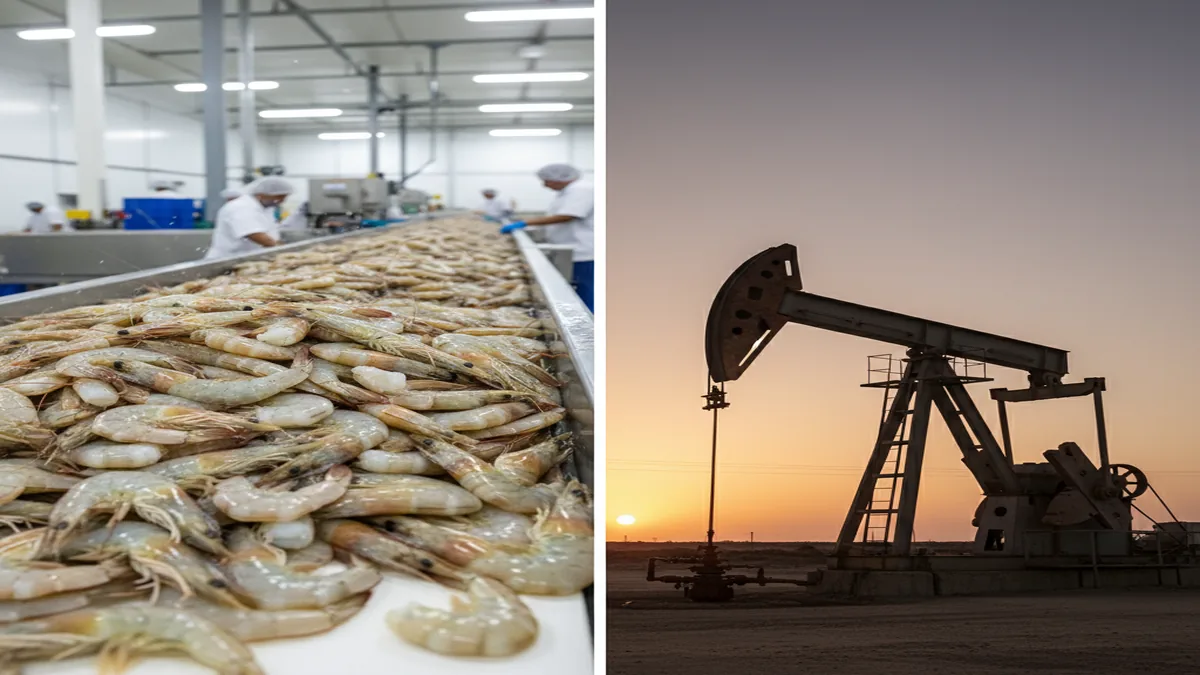
In a milestone that redefines Ecuador's economic identity, shrimp exports closed 2025 at $8.401 billion — officially surpassing petroleum exports at $7.750 billion to become the country's single largest export product for the first time in modern history. The shift ends petroleum's five-decade reign as Ecuador's dominant revenue generator and marks the culmination of a structural transformation in the national export profile.
Petroleum export revenues fell 19% year-on-year from $9.572 billion in 2024, driven by declining global oil prices and domestic production constraints. Meanwhile, shrimp revenues surged 20% on the back of recovering Asian demand and continued technification of Ecuador's aquaculture sector.
The crossover in numbers
| Product | 2024 exports | 2025 exports | YoY change |
|---|---|---|---|
| Shrimp | ~$7.0B | $8.401B | +20% |
| Petroleum (crude + derivatives) | $9.572B | $7.750B | −19% |
| Gap | Oil led by ~$2.6B | Shrimp leads by $651M | Reversal |
Why petroleum fell
Ecuador's petroleum sector has faced a cascade of structural challenges:
- Production decline: National output averaged ~349,000 bbl/d in 2025, down 8.5% year-on-year
- Pipeline disruptions: The SOTE pipeline rupture (March 2025) and advancing Coca river erosion forced temporary shutdowns
- Price weakness: WTI averaged $65–75/barrel in 2025, compared to $78–85/barrel in 2024
- Investment collapse: Public investment in EP Petroecuador fell 73% to $485 million
Why shrimp surged
- Asian demand recovery: China absorbed 48% of volume as post-COVID foodservice and e-commerce cold chain expanded
- Technification: Shift from extensive to semi-intensive farming increased yields 25–40% per hectare
- Volume growth: Record 1.39 million metric tonnes shipped, up 15% year-on-year
- Competitive positioning: US tariffs on Indian shrimp (26%+) gave Ecuador a relative cost advantage
Historical context
Petroleum has been Ecuador's dominant export since large-scale production began in the Amazon basin in the 1970s. The discovery of the Lago Agrio field and construction of the SOTE pipeline in 1972 transformed the economy. At its peak in 2013, crude oil accounted for more than 57% of total export revenue.
| Period | Top export | Share of total |
|---|---|---|
| 1970s–2010s | Crude petroleum | 40–57% |
| 2020–2024 | Crude petroleum (narrowing lead) | 25–35% |
| 2025 | Shrimp | ~27% |
Implications for economic policy
The shift has profound implications:
- Fiscal dependency: Oil revenues fund 25–30% of the national budget — a declining petroleum sector forces accelerated fiscal diversification
- Employment: Shrimp employs 250,000 workers directly and supports 500,000+ indirect livelihoods, compared to ~15,000 in petroleum
- Environmental calculus: Reduces pressure to expand Amazon oil extraction but raises questions about coastal ecosystem management
- Trade negotiation leverage: Strengthens the argument for prioritising aquaculture in bilateral trade deals, including the pending US-Ecuador reciprocal agreement
What to watch
Track monthly export data from the Central Bank to confirm whether the crossover is sustained through 2026. Monitor Petroecuador's production targets — any recovery above 400,000 bbl/d combined with oil above $80/barrel could narrow the gap. Watch CNA's 2026 growth projections (10–15%) for Q1 validation. The structural question is whether Ecuador's economic identity — and its fiscal, diplomatic, and infrastructure policy — adapts to the reality of being an aquaculture-first economy.
Sources: El Universo, El Diario, Radio Centro, BCE
Source
El Universo / El Diario / Radio Centro — “Es oficial: el petróleo ya no es el primer producto de exportación de Ecuador”
View originalSupport the EcuadorBrief archive.
Research support helps fund review, corrections, and hosting. New publishing is paused.