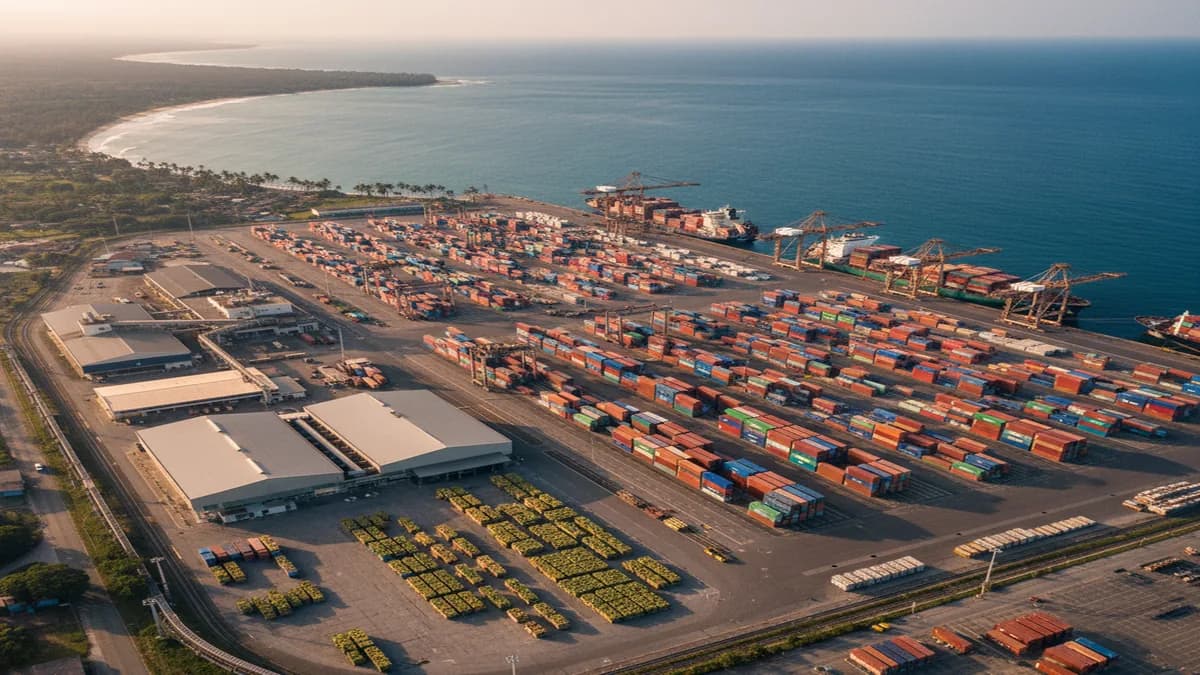
Global Cocoa Prices Crash 62% From 2025 Peak to $4,197/Ton — Ecuador's Rising Cacao Sector Faces Margin Squeeze as World's No. 4 Producer

Cocoa Market Collapse Hits Ecuador
Global cocoa futures have plunged approximately 62% over the past nine months, falling from highs above $11,000 per metric ton in mid-2025 to approximately $4,197/ton by mid-February 2026. The reversal ends a historic price surge driven by West African supply shortages and marks a return toward long-term trend levels — but with devastating implications for producers who invested at peak prices.
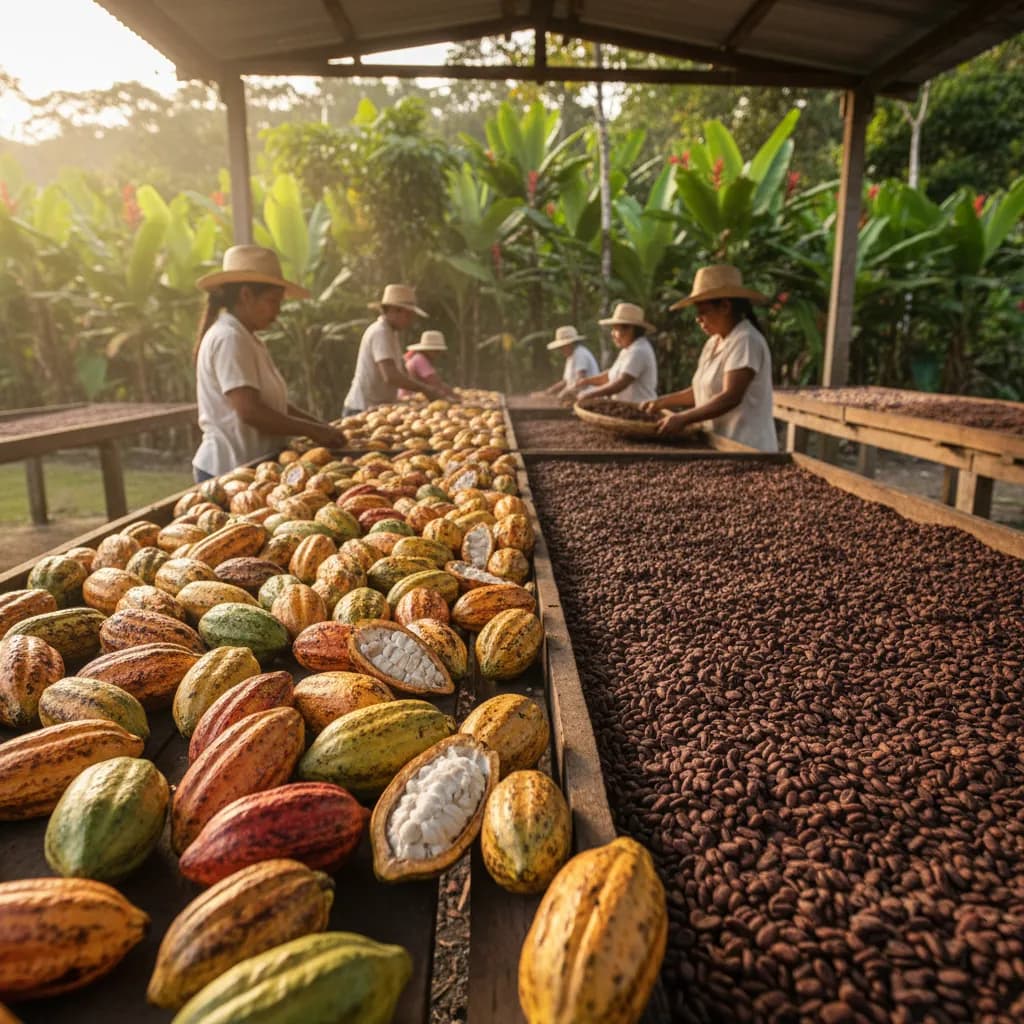
For Ecuador — the world's fourth-largest cocoa producer and the origin of approximately 60% of the world's fine-aroma cacao — the price crash creates a bifurcated impact depending on variety and market position.
Price trajectory
| Period | ICE cocoa futures ($/ton) | Change |
|---|---|---|
| Jan 2024 | ~$4,200 | Baseline |
| Apr 2024 | ~$9,500 | +126% |
| Jul 2025 | ~$11,200 | Peak |
| Oct 2025 | ~$8,100 | -28% from peak |
| Jan 2026 | ~$5,400 | -52% from peak |
| Feb 2026 | ~$4,197 | -62% from peak |
What caused the crash
Supply recovery in West Africa is the primary driver. Côte d'Ivoire and Ghana — which together produce approximately 60% of global cocoa — experienced severe crop failures in 2023-2024 due to drought, disease (swollen shoot virus), and aging tree stock. As replanting programs and improved weather conditions took effect in late 2025, production forecasts improved significantly:
| Country | 2024/25 production | 2025/26 forecast | Change |
|---|---|---|---|
| Côte d'Ivoire | ~1.7M tons | ~2.1M tons | +24% |
| Ghana | ~650K tons | ~850K tons | +31% |
| Ecuador | ~380K tons | ~400K tons | +5% |
| Indonesia | ~320K tons | ~340K tons | +6% |
Additional factors include:
- Speculative unwind — hedge funds that drove prices above $10,000 exited long positions aggressively
- Demand destruction — chocolate manufacturers reduced cocoa content and raised retail prices, suppressing consumption
- Dollar strength — the stronger US dollar reduces commodity prices denominated in dollars
Ecuador's cacao sector: two markets
Ecuador's cacao industry operates in two distinct market segments with very different exposure to the price crash:
Nacional (fine-aroma) cacao:
- Represents ~35-40% of Ecuador's production
- Commands a $300-800/ton premium over commodity cocoa
- Primary buyers: European and Japanese artisanal chocolate makers
- Current effective price: ~$4,800-5,000/ton
- Margin impact: Moderate — premium partially buffers the decline
CCN-51 (bulk/commodity) cacao:
- Represents ~60-65% of Ecuador's production
- Priced at or near the ICE benchmark
- Primary buyers: Industrial chocolate manufacturers
- Current effective price: ~$4,100-4,200/ton
- Margin impact: Severe — approaching break-even for many producers
| Metric | Nacional | CCN-51 |
|---|---|---|
| Production share | 35-40% | 60-65% |
| Current price | $4,800-5,000/ton | $4,100-4,200/ton |
| Estimated cost of production | $2,800-3,200/ton | $3,200-3,800/ton |
| Margin at current prices | $1,600-2,200/ton | $300-1,000/ton |
| Break-even risk | Low | Moderate to high |
Export impact
Ecuador exported approximately $1.2 billion in cacao and cacao products in 2025, making it the country's fourth-largest non-oil export after shrimp, bananas, and flowers. ANECACAO data shows:
| Metric | 2024 | 2025 | 2026 (projected) |
|---|---|---|---|
| Export volume | ~360,000 tons | ~380,000 tons | ~400,000 tons |
| Export value | ~$1.5B | ~$1.2B | ~$900M-1.0B |
| Average price/ton | ~$4,200 | ~$3,150 | ~$2,250-2,500 |
The volume increase is being more than offset by the price decline, potentially reducing export revenue by $200-300 million compared to 2025.
Investment implications
Ecuador had been investing heavily in cacao sector expansion, with government-backed programs through BanEcuador and CFN providing credit for farm renovation, high-yield plantings, and processing facilities. At current prices, some of these investments face extended payback periods:
- New CCN-51 plantations financed at $5,000+/hectare may not achieve break-even for 4-5 years
- Processing facilities (semi-finished cacao products) retain better margins due to value-add
- Fine-aroma certification programs become more valuable as the premium widens relative to bulk
What to watch
Monitor the ICCO quarterly production forecast for signs that West African supply recovery stalls — any setback (drought, disease) could reverse the price decline rapidly. Track ANECACAO monthly export data for volume trends that offset price weakness. Watch for government support measures — subsidized credit extensions, input cost subsidies, or minimum price programs for small producers. Compare Ecuador's fine-aroma premium trajectory against the benchmark — a widening premium indicates resilient demand for Ecuador's differentiated product.
Sources: Nairametrics, ICCO, ANECACAO, Bloomberg
Source
Nairametrics / ICCO / Bloomberg — “From boom to bust: What really led to the cocoa price fall”
View originalSupport the EcuadorBrief archive.
Research support helps fund review, corrections, and hosting. New publishing is paused.