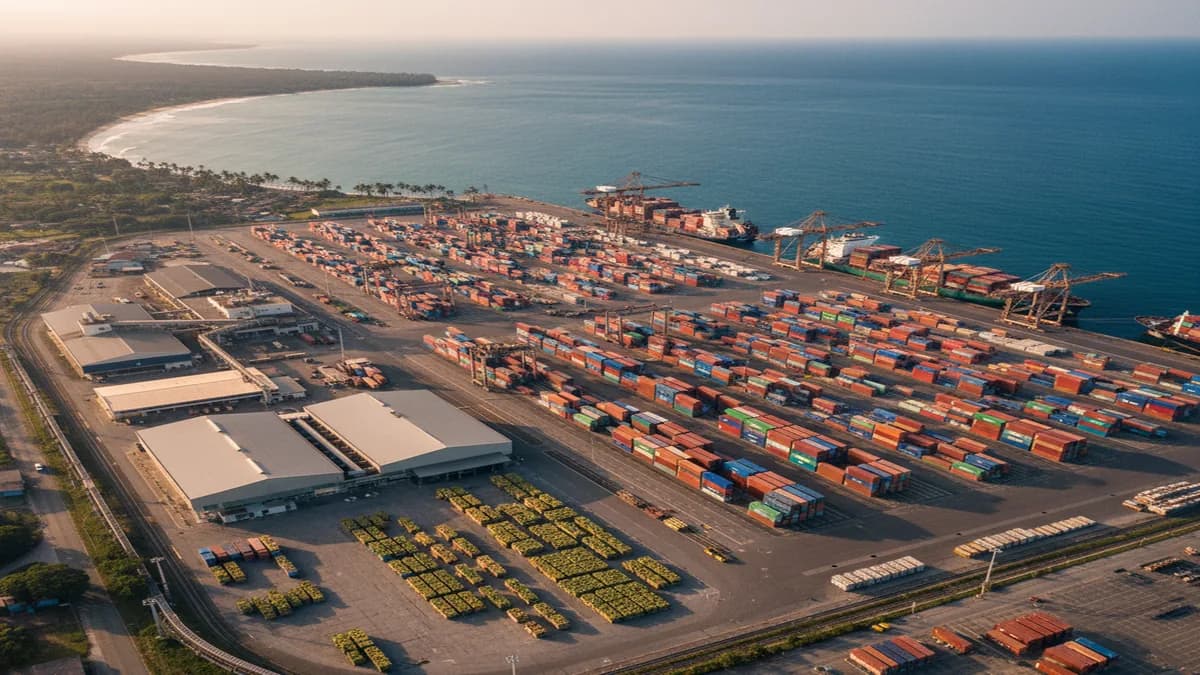
Oil Production Falls to 466K bpd — 13% Below Decade Ago

Production Decline
Ecuador's crude oil production has declined to approximately 466,000 barrels per day (bpd), representing a 13% drop from output levels a decade ago and a 100,000 bpd gap below the government's fiscal budget target of 566,000 bpd. The shortfall has direct implications for government revenue, trade balance, and dollarization stability.
Production Trajectory
| Year | Average Production (bpd) | Change |
|---|---|---|
| 2014 | ~557,000 | Peak period |
| 2018 | ~517,000 | -7% from 2014 |
| 2020 | ~475,000 | COVID + pipeline disruption |
| 2023 | ~480,000 | Partial recovery |
| 2025 | ~470,000 | Continued decline |
| 2026 (current) | ~466,000 | -13% from decade ago |
| 2026 budget target | 566,000 | 100K bpd gap |
The decline is structural, not cyclical. Ecuador's major producing fields — particularly in the Oriente basin — are mature assets that have been producing for 30-40 years. Natural depletion rates of 5-8% annually require continuous investment in enhanced oil recovery (EOR), infill drilling, and new field development to maintain output.
Fiscal Impact
The 100,000 bpd production shortfall translates directly into lost government revenue:
| Metric | Value |
|---|---|
| Revenue gap (est.) | ~$2.0B annually at $70/bbl |
| Oil revenue % of budget | ~25% |
| Ecuadorian crude discount (Oriente) | ~$8-10/bbl below WTI |
| Fiscal breakeven price | ~$55-60/bbl |
While Ecuador remains above its fiscal breakeven price, the volume shortfall means the government collects significantly less revenue than budgeted, constraining spending on infrastructure, security, and social programs.
Causes of Decline
Mature field depletion: The ITT block (Ishpingo-Tambococha-Tiputini) was expected to offset declines elsewhere but has underperformed initial projections. Legacy fields operated by Petroecuador require increasingly expensive secondary and tertiary recovery techniques.
Underinvestment: Years of fiscal austerity, political uncertainty, and unfavorable contract terms for private operators have suppressed upstream investment. Ecuador's investment-per-barrel ratio is among the lowest in Latin America.
Infrastructure constraints: Pipeline capacity, road access in the Amazon basin, and processing facility limitations cap the rate at which new production can be brought online.
Regulatory environment: Private operators, who account for approximately 25% of total production, have cited contract instability and renegotiation risk as deterrents to expanded investment.
What to Watch
- Petroecuador's production plan — the state company's targets for ITT block optimization and EOR programs at mature fields
- Private operator contract terms — whether the government offers improved fiscal terms to incentivize upstream investment
- OPEC dynamics — Ecuador left OPEC in 2020, but global supply/demand dynamics still affect the price Ecuador receives for its heavy crude
- Pipeline infrastructure — the SOTE and OCP pipelines have available capacity; the constraint is upstream production, not transport
Sources: OilPrice
Support the EcuadorBrief archive.
Research support helps fund review, corrections, and hosting. New publishing is paused.