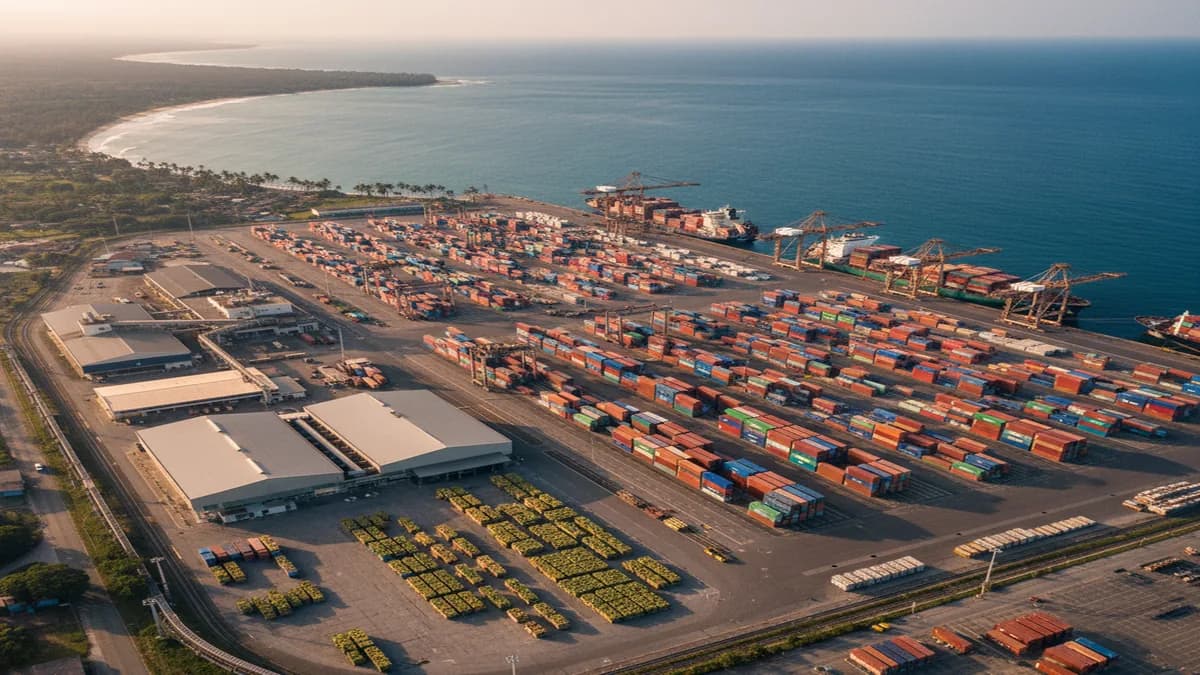
U.S.-Ecuador Reciprocal Trade Agreement Eliminates Tariffs on $2.786B in Non-Oil Exports

Agreement Structure
USTR Ambassador Jamieson Greer and Ecuador's Minister of Production, Foreign Trade, Investments, and Fisheries Luis Alberto Jaramillo signed the U.S.-Ecuador Agreement on Reciprocal Trade on March 13, 2026, in Washington, D.C. The agreement represents the most significant bilateral trade liberalization between the two countries since Ecuador's accession to the Andean Trade Preference Act in 1991.
| Parameter | Detail |
|---|---|
| Signing date | March 13, 2026 |
| U.S. signatory | USTR Ambassador Jamieson Greer |
| Ecuador signatory | Minister Luis Alberto Jaramillo |
| Non-oil exports covered | $2.786 billion (53% of lines) |
| Implementation | Phased, 0-3 years |
| Type | Executive agreement (no Congressional ratification required) |
Coverage and Scope
The agreement addresses non-oil trade flows between the two countries, deliberately excluding petroleum products, which account for approximately 40% of Ecuador's total exports to the United States.
U.S. Market Access for Ecuador
| Product Category | Pre-Agreement Tariff | Post-Agreement | Phase-In |
|---|---|---|---|
| Shrimp (frozen) | 0% (GSP) | 0% (locked in) | Immediate |
| Cut flowers | 0-6.8% | 0% | Immediate |
| Cacao beans | 0% | 0% (locked in) | Immediate |
| Processed foods | 2-12% | 0% | 1-2 years |
| Textiles/apparel | 5-32% | Reduced | 2-3 years |
| Handicrafts | Various | 0% | Immediate |
The agreement locks in duty-free treatment for products that previously entered under the Generalized System of Preferences (GSP), which is subject to periodic Congressional renewal and has lapsed multiple times. This provides tariff certainty that GSP alone could not guarantee.
Ecuador Market Access for U.S.
| Product Category | Pre-Agreement Tariff | Post-Agreement | Phase-In |
|---|---|---|---|
| Beef | 25-30% | 0% | 3 years |
| Pork | 45% | 0-5% | Immediate-2 years |
| Dairy | 20-35% | Reduced | 2-3 years |
| Agricultural machinery | 5-15% | 0% | Immediate |
| Medical equipment | 0-10% | 0% | Immediate |
| IT/telecom equipment | 5-15% | 0% | 1 year |
Ecuador granted preferential treatment covering 90%+ of the U.S. agricultural tariff schedule, a significant concession driven by domestic consumer demand for competitively priced protein imports.
Bilateral Trade Context
| Metric | Value | Period |
|---|---|---|
| Total bilateral trade | $12.4 billion | 2025 |
| Ecuador exports to U.S. | $7.8 billion | 2025 |
| U.S. exports to Ecuador | $4.6 billion | 2025 |
| Non-oil Ecuador exports to U.S. | $5.26 billion | 2025 |
| Coverage (this agreement) | $2.786 billion | -- |
| U.S. trade deficit with Ecuador | $3.2 billion | 2025 |
The United States is Ecuador's largest single-country export market, absorbing approximately 28% of total exports. Ecuador is the largest U.S. trade partner in the Andean region by volume.
Digital Trade Provisions
The agreement includes a digital trade chapter -- a first for Ecuador's bilateral trade architecture. Key provisions include:
- Prohibition on customs duties for digital products transmitted electronically
- Data localization restrictions -- neither party may require companies to store data on local servers as a condition of market access
- Source code protection -- prohibits forced disclosure of proprietary algorithms
- Consumer protection frameworks for cross-border e-commerce transactions
- Electronic signatures recognized for trade documentation
These provisions align Ecuador's digital trade framework with USMCA standards, potentially facilitating integration into North American supply chains for digital services.
Agricultural Sector Impact
Ecuador's Livestock Sector
The elimination of pork tariffs (from 45%) and beef tariff phase-down will create competitive pressure on domestic producers:
- Ecuador's pork production -- approximately 180,000 MT annually -- serves a domestic market accustomed to higher prices. U.S. pork imports at reduced tariffs could capture 15-20% market share within 3 years
- Beef imports currently average $85 million annually from all sources; the tariff phase-down could increase U.S. share from ~12% to ~30%
- Dairy sector faces moderate exposure, with the Asociación de Ganaderos de la Sierra y Oriente (AGSO) expressing concerns about market disruption
U.S. Agricultural Exporters
For U.S. producers, Ecuador represents a $350 million addressable market expansion in agricultural products, with protein exports (beef, pork, poultry) accounting for the largest potential gains.
Geopolitical Dimensions
The agreement reflects several strategic considerations:
- China counterprogramming -- Ecuador signed a free trade agreement with China in 2024; the U.S. deal balances China's growing trade influence in the Andean region
- Narcotics cooperation linkage -- trade liberalization coincides with expanded DEA operations and the March 2026 FBI office opening in Quito
- IMF alignment -- the agreement supports Ecuador's broader economic reform agenda under the $4.6 billion Extended Fund Facility
- Regional signaling -- the deal may encourage similar bilateral agreements with Colombia and Peru, which lack comprehensive trade pacts with the U.S. outside ATPDEA/ATPA frameworks
Implementation Challenges
- Sanitary and phytosanitary (SPS) standards -- Ecuador must align inspection protocols for U.S. agricultural imports; Agrocalidad capacity is a bottleneck
- Rules of origin verification -- customs enforcement at SENAE requires modernization to process preferential treatment claims at volume
- Domestic political opposition -- agricultural producer associations have signaled resistance to livestock tariff reductions
- Regulatory harmonization for digital trade provisions requires legislative action
What to Watch
- Congressional response -- while structured as an executive agreement, Congressional trade hawks may challenge the scope of tariff concessions
- SPS implementation timeline -- delays in sanitary protocol alignment could defer actual trade flow changes
- Ecuador pork and beef import volumes in Q2-Q3 2026 -- early indicators of market impact
- Digital trade chapter enforcement -- Ecuador's first experience implementing USMCA-standard digital provisions
- China FTA utilization rates versus U.S. agreement utilization -- comparative adoption will signal Ecuador's trade orientation
- ATPDEA renewal dynamics -- whether the bilateral agreement reduces pressure to renew the multilateral framework
Source: USTR
Support the EcuadorBrief archive.
Research support helps fund review, corrections, and hosting. New publishing is paused.