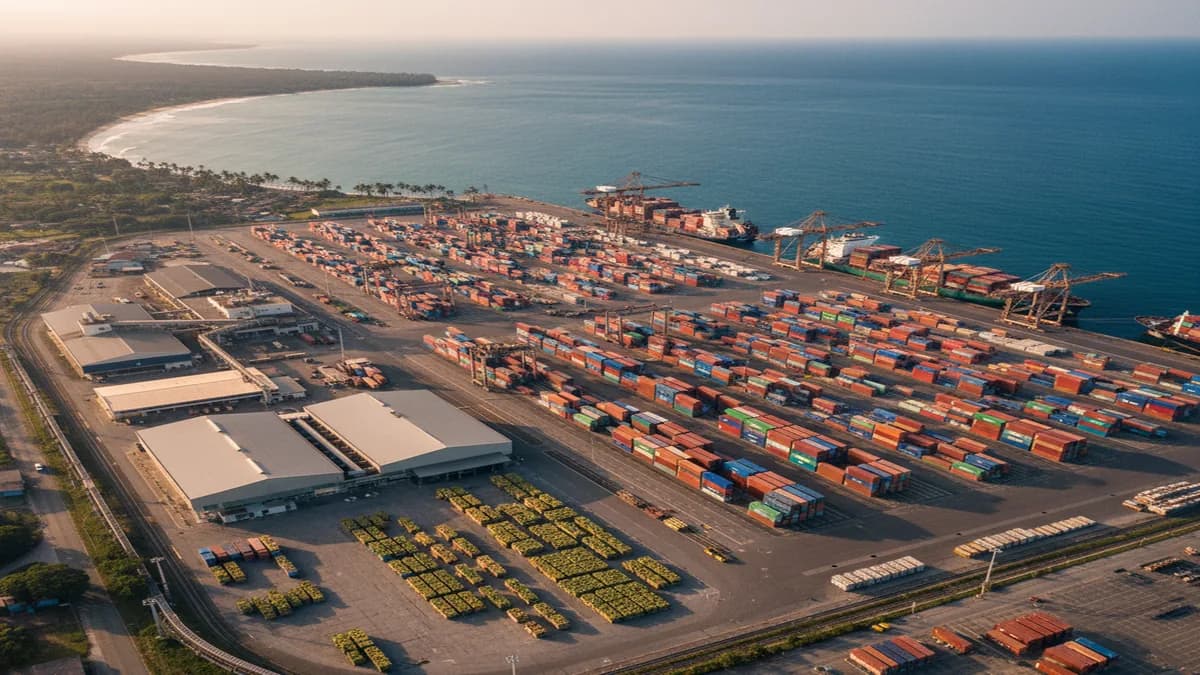
Ecuadorian Banana Exporters Target 25% South Korea Market Share by 2031 — AEBE Projects $100M Annual FX

The Projection
José Antonio Hidalgo, "director ejecutivo de la Asociación de Exportadores de Banano del Ecuador" (AEBE), told El Universo that Ecuador's banana exporters project 25% market share in South Korea by 2031, up from 11% today, once SECA (the Strategic Economic Cooperation Agreement) fully eliminates the 30% tariff (source).
The agreement was ratified by presidential Decreto Ejecutivo 359 on April 16.
Baseline and Target
| Metric | 2025 Baseline | 2031 Target |
|---|---|---|
| Market share | 11% | 25% |
| Volume | 3.57 million boxes | Not stated |
| Tariff | 30% | 0% |
| Annual FX | Not disclosed | ~$100M |
Tariff Elimination Structure
Per the article, banana tariffs "se desgravará en cinco años, es decir, la fruta ingresará con el 0 % en 2031." This is a phased elimination — not an immediate cut. Contrast with shrimp, which under SECA sees its 20% tariff eliminated immediately upon agreement entry into force.
The phased structure for banana reflects standard treatment for sensitive agricultural products: South Korea's protected agricultural sector required a transition window.
Economic Implications
At 25% share, AEBE estimates annual FX earnings of roughly $100 million. For context:
- Ecuador's total 2025 banana exports to South Korea (at 11% share): implied volume ~3.57M boxes
- Doubling share to 25% plausibly doubles volume and FX earnings
- The 2031 target aligns with the end of the five-year phase-out
Competitive Positioning
The article does not name specific competing country shares, but the remaining ~89% of Korean banana imports are typically dominated by Philippines, with smaller shares from other LatAm and Asian origins. Ecuador's phase-out timeline — 2031 — puts its banana producers at structural parity with or better than many competitors on tariff terms.
Sector Significance
Banana is Ecuador's second-largest non-petroleum export by value, consistently among the country's top three overall exports. Expanding Asian market access has been a multi-decade objective for AEBE; the SECA banana language is among the most commercially meaningful provisions in the 23-chapter agreement.
What to Watch
- SECA entry-into-force date. While Noboa ratified on April 16 via Decreto 359, Korean ratification and formal exchange of instruments are required. Timeline determines when the five-year phase-out clock starts.
- Year-one volume data. 2027 Korean import data (first full year post-entry) will show whether share gains materialize on schedule or lag.
- Producer investment response. AEBE-member producers may front-load capacity expansion in anticipation of 2031 tariff elimination. Watch for capex announcements from majors like Reybanpac, Palmar, Truisfruit, and others.
- Korean agricultural-sector pushback. Domestic Korean banana sector (small relative to imports) may lobby for tariff-rate-quota extensions or non-tariff barriers. Precedent from Chile-Korea, Peru-Korea FTAs is mixed.
- EU banana access comparisons. Ecuador's banana access to the EU and Korea are now both on structural improvement trajectories; total Asia+EU exports could materially rebalance against traditional US/LatAm concentration.
Source: El Universo
Source
El Universo — “Exportadores de banano esperan llegar al 25 % del mercado surcoreano”
View originalSupport the EcuadorBrief archive.
Research support helps fund review, corrections, and hosting. New publishing is paused.