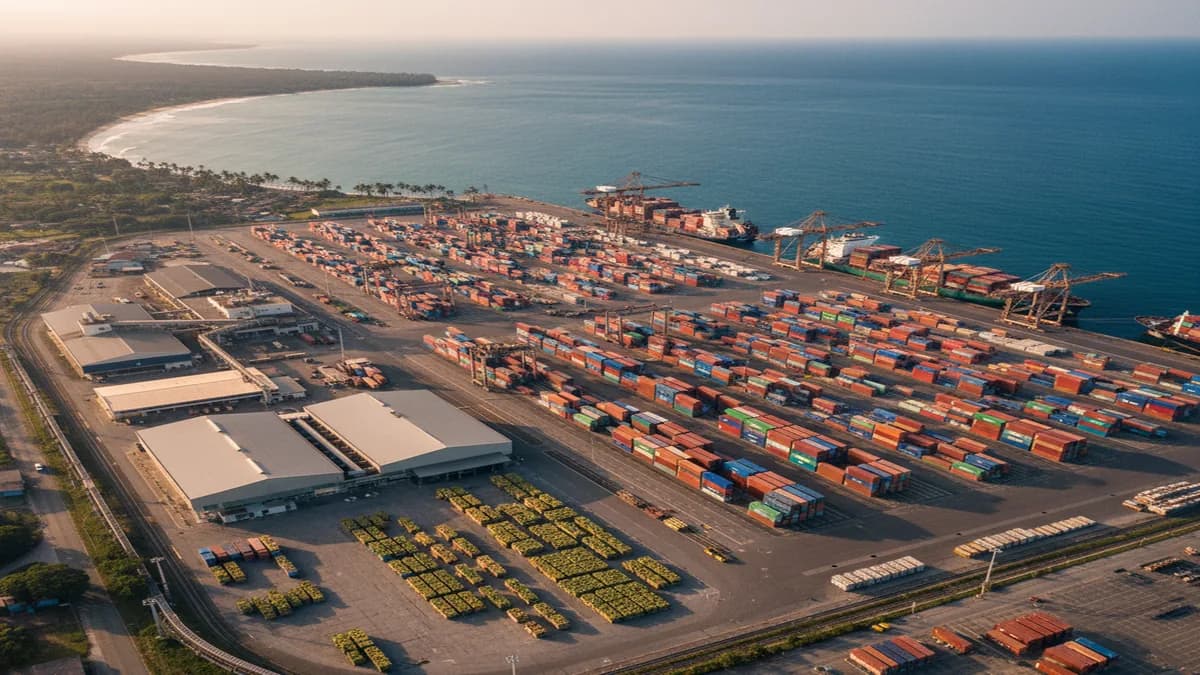
Cacao Exports Projected at 623,000+ MT; Ecuador to Surpass Ghana as World No. 2

Production Trajectory
Anecacao (Asociación Nacional de Exportadores de Cacao e Industrializados del Ecuador) projects Ecuador's cacao exports will exceed 623,000 metric tonnes (MT) in 2026, a trajectory that would position the country to surpass Ghana as the world's second-largest cacao producer, trailing only Cote d'Ivoire.
| Year | Exports (MT) | YoY Growth | Global Rank |
|---|---|---|---|
| 2023 | 375,720 | +12.3% | #4 |
| 2024 | 480,000 (est.) | +27.7% | #3 |
| 2025 | 560,000 (est.) | +16.7% | #3 |
| 2026 (proj.) | 623,000+ | +11.3% | #2 (projected) |
| 2026/27 season | 650,000+ (est.) | -- | #2 |
| 2030 target | 800,000 | -- | #2 |
The growth trajectory represents an extraordinary 66% increase in just three years (2023-2026), driven by a combination of expanded planting area, improved agronomic practices, and favorable international pricing.
Global Market Position
Ecuador's ascent in the cacao rankings reflects both domestic expansion and production challenges in West Africa:
| Country | 2025/26 Prod. (est. MT) | Global Share | Trend |
|---|---|---|---|
| Cote d'Ivoire | 1,800,000 | ~38% | Declining |
| Ghana | 620,000 | ~13% | Declining |
| Ecuador | 623,000+ | ~13% | Growing |
| Cameroon | 380,000 | ~8% | Stable |
| Nigeria | 350,000 | ~7% | Stable |
| Indonesia | 280,000 | ~6% | Declining |
Why Ecuador Is Gaining
- West African production crisis -- Ghana's output has collapsed from 1 million MT (2020/21) to an estimated 620,000 MT due to cocoa swollen shoot virus (CSSV), aging tree stock, and illegal mining destroying farmland
- Cote d'Ivoire deforestation limits -- the world's largest producer is approaching the boundaries of available forest land for expansion
- Ecuador's expansion potential -- significant available land in Los Ríos, Guayas, Manabí, and Esmeraldas provinces remains suitable for cacao cultivation
Price Environment
Global cacao prices have experienced extraordinary volatility:
| Period | ICE Cacao Futures ($/MT) | YoY Change |
|---|---|---|
| Jan 2024 | $4,200 | +45% |
| Apr 2024 | $11,700 (record) | +180% |
| Dec 2024 | $8,500 | +102% |
| Mar 2026 | $7,200 | -15% (vs peak) |
| 5-year average | $3,800 | -- |
Prices remain nearly double the five-year average, providing strong economic incentives for Ecuadorian producers to expand planting and improve yields. At $7,200/MT, Ecuador's 623,000 MT in projected exports would generate approximately $4.5 billion in annual revenue.
Ecuador's Cacao Advantage: Nacional Fino de Aroma
Ecuador produces approximately 60% of the world's fino de aroma cacao -- a premium variety commanding significant price premiums:
| Variety | Share of Ecuador Output | Price Premium vs. Bulk |
|---|---|---|
| Nacional Fino de Aroma | ~55-60% | +30-60% |
| CCN-51 (hybrid) | ~35-40% | Baseline |
| Other varieties | ~5% | Variable |
The Nacional variety is prized by artisanal chocolate makers for its floral, fruity, and complex flavor profile -- a direct result of Ecuador's unique terroir, altitude, and equatorial climate. Major buyers include:
- Valrhona (France)
- Felchlin (Switzerland)
- Guittard (United States)
- Callebaut (Belgium)
Production Geography
| Province | Share of Production | Hectares | Primary Variety |
|---|---|---|---|
| Los Ríos | ~28% | ~145,000 | CCN-51, Nacional |
| Guayas | ~22% | ~115,000 | CCN-51 |
| Manabí | ~18% | ~95,000 | Nacional |
| Esmeraldas | ~15% | ~78,000 | Nacional |
| El Oro | ~8% | ~42,000 | CCN-51 |
| Other | ~9% | ~47,000 | Mixed |
| Total | 100% | ~522,000 | -- |
Total cacao area has expanded from approximately 450,000 hectares in 2021 to ~522,000 hectares in 2026, with new plantings concentrated in Los Ríos and Esmeraldas.
Value Chain Development
Ecuador is working to move up the cacao value chain beyond raw bean exports:
| Product | Share of Exports | Revenue (est.) | Growth |
|---|---|---|---|
| Raw beans | ~70% | $3.15B | +15% |
| Cocoa butter | ~12% | $540M | +20% |
| Cocoa powder | ~8% | $360M | +18% |
| Cocoa paste/liquor | ~7% | $315M | +22% |
| Finished chocolate | ~3% | $135M | +30% |
The fastest growth is in semi-processed and finished products, reflecting investments in processing capacity. Pacari, República del Cacao, and Hoja Verde are leading the finished chocolate export segment.
Export Markets
| Destination | Share (2025) | Value (est.) |
|---|---|---|
| Indonesia | ~22% | $990M |
| United States | ~18% | $810M |
| Netherlands | ~14% | $630M |
| Malaysia | ~12% | $540M |
| Germany | ~8% | $360M |
| Other | ~26% | $1.17B |
Sector Challenges
- Cadmium contamination -- EU regulations limiting cadmium in chocolate affect Ecuadorian exports; compliance costs of $10-15/MT for testing and blending
- Aging tree stock -- approximately 40% of Nacional trees are over 25 years old with declining yields
- Small producer fragmentation -- 85% of cacao farms are under 10 hectares, limiting mechanization and quality control
- Climate risk -- excessive rainfall during flowering reduces pod set; drought during development reduces bean quality
What to Watch
- 2026/27 season harvest data (October-November) -- whether actual production reaches the 650,000 MT projection
- Ghana production data -- the timing of Ecuador surpassing Ghana depends on Ghana's continued decline
- ICE cacao futures trajectory -- sustained prices above $6,000/MT incentivize further expansion; a correction below $4,000 would pressure margins
- EU cadmium regulation tightening -- stricter limits in 2027 could require additional compliance investment
- Value-added processing investment -- new grinding and chocolate manufacturing capacity announcements
- CCN-51 versus Nacional mix -- the industry balance between volume (CCN-51) and premium positioning (Nacional) has strategic implications
Source: Reuters / Anecacao
Support the EcuadorBrief archive.
Research support helps fund review, corrections, and hosting. New publishing is paused.